
-
 Argentina
-
 Australia
-
 Austria
-
 Belgium
-
 Brazil
-
 Canada
-
 China
China
-
 Czech Republic
-
 Denmark
-
 Finland
-
 France
-
 Germany
-
 Greece
-
 Hong Kong
-
 Hungary
-
 Iceland
-
 India
India
-
 Ireland
-
 Israel
-
 Italy
Italy
-
 Japan
Japan
-
 Korea
Korea
-
 Luxembourg
-
 Malaysia
-
 Netherlands
-
 New Zealand
-
 Norway
-
 Poland
-
 Portugal
-
 Qatar
Qatar
-
 Romania
-
 Saudi Arabia
-
 Singapore
-
 Spain
Spain
-
 Sweden
-
 Switzerland
-
 Taiwan
-
 Turkey
-
 United Kingdom
-
 United States
research use only
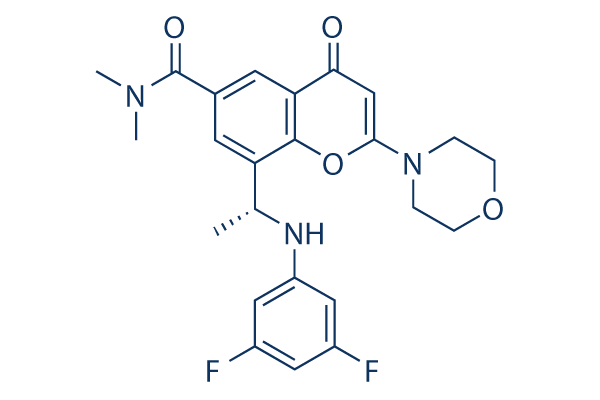
AZD8186 PI3K inhibitor
Cat.No.S7694
Quality Control
| Related Targets | Akt mTOR GSK-3 ATM/ATR DNA-PK AMPK PDPK1 PTEN PI4K PP2A |
|---|---|
| Other PI3K Inhibitors | GDC-0077 (Inavolisib) SAR405 Quercetin (Sophoretin) LY294002 XL147 analogue Tersolisib (STX-478) Buparlisib (BKM120) 740 Y-P (PDGFR 740Y-P) GO-203 TFA Eganelisib (IPI-549) |
Cell Culture, Treatment & Working Concentration
| Cell Lines | Assay Type | Concentration | Incubation Time | Formulation | Activity Description | PMID |
|---|---|---|---|---|---|---|
| MDA-MB-468 | Function assay | 2 hrs | Inhibition of PI3Kbeta in PTEN-null human MDA-MB-468 cells assessed as inhibition of Akt phosphorylation after 2 hrs, IC50=0.003μM | 25514658 | ||
| Jeko B | Function assay | 2 hrs | Inhibition of PI3Kdelta in human Jeko B cells assessed as inhibition of Akt phosphorylation after 2 hrs, IC50=0.017μM | 25514658 | ||
| BT474 | Function assay | 2 hrs | Inhibition of PI3Kalpha mutant human BT474 cells assessed as inhibition of Akt phosphorylation at Tyr-308 after 2 hrs, IC50=0.752μM | 25514658 | ||
| PC3 | Function assay | 100 mg/kg | Inhibition of Akt phosphorylation at Ser473 in PTEN-deficient human PC3 cells xenograft mouse model at 100 mg/kg, po single dose measured up to 8 hrs | 25514658 | ||
| PC3 | Antitumor assay | 30 mg/kg | Antitumor activity against human PC3 cells xenograft mouse model assessed as inhibition of tumor growth at 30 mg/kg, po bid in presence of 1-aminobenzotriazole | 25514658 | ||
| PC3 | Antitumor assay | 60 mg/kg | Antitumor activity against human PC3 cells xenograft mouse model assessed as inhibition of tumor growth at 60 mg/kg, po bid in presence of 1-aminobenzotriazole | 25514658 | ||
| Click to View More Cell Line Experimental Data | ||||||
Solubility
|
In vitro |
DMSO
: 79 mg/mL
(172.68 mM)
Ethanol : 3 mg/mL Water : Insoluble |
Molarity Calculator
|
In vivo |
|||||
In vivo Formulation Calculator (Clear solution)
Step 1: Enter information below (Recommended: An additional animal making an allowance for loss during the experiment)
Step 2: Enter the in vivo formulation (This is only the calculator, not formulation. Please contact us first if there is no in vivo formulation at the solubility Section.)
Calculation results:
Working concentration: mg/ml;
Method for preparing DMSO master liquid: mg drug pre-dissolved in μL DMSO ( Master liquid concentration mg/mL, Please contact us first if the concentration exceeds the DMSO solubility of the batch of drug. )
Method for preparing in vivo formulation: Take μL DMSO master liquid, next addμL PEG300, mix and clarify, next addμL Tween 80, mix and clarify, next add μL ddH2O, mix and clarify.
Method for preparing in vivo formulation: Take μL DMSO master liquid, next add μL Corn oil, mix and clarify.
Note: 1. Please make sure the liquid is clear before adding the next solvent.
2. Be sure to add the solvent(s) in order. You must ensure that the solution obtained, in the previous addition, is a clear solution before proceeding to add the next solvent. Physical methods such
as vortex, ultrasound or hot water bath can be used to aid dissolving.
Chemical Information, Storage & Stability
| Molecular Weight | 457.47 | Formula | C24H25F2N3O4 |
Storage (From the date of receipt) | |
|---|---|---|---|---|---|
| CAS No. | 1627494-13-6 | Download SDF | Storage of Stock Solutions |
|
|
| Synonyms | N/A | SMILES | CC(C1=CC(=CC2=C1OC(=CC2=O)N3CCOCC3)C(=O)N(C)C)NC4=CC(=CC(=C4)F)F | ||
Read more about storage stability stock solution CAS number SMILES
Mechanism of Action
| Targets/IC50/Ki |
PI3Kβ
(Cell-free assay) 4 nM
PI3Kδ
(Cell-free assay) 12 nM
PI3Kα
(Cell-free assay) 35 nM
|
|---|---|
| In vitro |
AZD8186 potently inhibits p-Akt in MDA-MB-468 cells sensitive to PI3Kβ inhibition and Jeko B cells sensitive to PI3Kδ inhibition with IC50 of 3 nM and 4 nM, respectively. This compound shows preferred growth inhibition activity in most PTEN deficient cell lines with GI50 of <1 μM.
|
| Kinase Assay |
PI3Kα, PI3Kβ, PI3Kγ and PI3Kδ enzyme assays
|
|
The inhibition of PI3Kα, PI3Kβ, PI3Kγ and PI3Kδ human recombinant PI3K isoforms is evaluated using a Kinase-Glo Plus Assay Kit. 12 point half-log concentration-response curves with a top concentration of 100 μM are constructed by dispensing DMSO solubilised compounds into white 384-well medium-binding microplates using an Echo 555. 3 μL of the appropriate PI3K in Tris buffer (50 mM Tris pH7.4, 0.05% CHAPS, 2.1 mM DTT, and 10 mM MgCl2) is added. The plate is covered and allowed to pre-incubate with compound for 20 minutes prior to addition of 3 μL of substrate solution containing PIP2 and ATP. The enzyme reaction is stopped after 80 minutes by the addition of Kinase Glo detection solution. Plates are covered and incubated for 30 minutes at room temperature before the luminescence signal is read using a PHERAstar plate reader. The final concentrations of DMSO, ATP and PIP2 in the assay are 2%, 8 μM, and 80 μM respectively. The final concentrations of PI3Kα, PI3Kβ, PI3Kγ and PI3Kδ are respectively 20 nM, 20 nM, 45 nM and 30 nM. For PI3Kα, PI3Kβ and PI3Kδ the concentration of active enzyme is determined as outlined in the enzyme assay tight binding limit determination section. For PI3Kγ the concentration of enzyme is determined by Bradford assay. IC50 values are calculated using Genedata Screener.
|
|
| In vivo |
In nude mice bearing PTEN-deficient PC3 prostate tumor xenografts, AZD8186 (100 mg/kg, p.o.) strongly inhibits Akt phosphorylation levels, and causes significant tumor growth inhibition. When used in combination with ABT, this compound (60 mg/kg, p.o.) results in complete inhibition of tumor growth. In the mouse PTEN-null TNBC models HCC70 and MDA-MB-468, and the prostate models HID28, this chemical (50 mg/kg, p.o.) also inhibits the growth of tumors. Combination therapy using this compound with androgen deprivation results in long-lasting tumor regression, which persisted after treatment cessation.
|
References |
|
Clinical Trial Information
(data from https://clinicaltrials.gov, updated on 2026-04-29)
| NCT Number | Recruitment | Conditions | Sponsor/Collaborators | Start Date | Phases |
|---|---|---|---|---|---|
| NCT03218826 | COMPLETED | Advanced Breast Carcinoma; Advanced Malignant Solid Neoplasm; Advanced Prostate Carcinoma; Anatomic Stage III Breast Cancer AJCC v8; Anatomic Stage IIIA Breast Cancer AJCC v8; Anatomic Stage IIIB Breast Cancer AJCC v8; Anatomic Stage IIIC Breast Cancer AJCC v8; Anatomic Stage IV Breast Cancer AJCC v8; Castration-Resistant Prostate Carcinoma; Metastatic Breast Carcinoma; Metastatic Malignant Solid Neoplasm; Metastatic Prostate Carcinoma; Prognostic Stage III Breast Cancer AJCC v8; Prognostic Stage IIIA Breast Cancer AJCC v8; Prognostic Stage IIIB Breast Cancer AJCC v8; Prognostic Stage IIIC Breast Cancer AJCC v8; Prognostic Stage IV Breast Cancer AJCC v8; Stage III Prostate Cancer AJCC v8; Stage IIIA Prostate Cancer AJCC v8; Stage IIIB Prostate Cancer AJCC v8; Stage IIIC Prostate Cancer AJCC v8; Stage IV Prostate Cancer AJCC v8; Stage IVA Prostate Cancer AJCC v8; Stage IVB Prostate Cancer AJCC v8; Triple-Negative Breast Carcinoma; Unresectable Solid Neoplasm |
National Cancer Institute (NCI) |
2018-09-24 | PHASE1 |
| NCT04001569 | UNKNOWN | Solid Tumor; Stomach Cancer |
Seoul National University Bundang Hospital |
2019-05-14 | PHASE1; PHASE2 |
| NCT01884285 | COMPLETED | Advanced Castrate-resistant Prostate Cancer CRPC; Squamous Non-Small Cell Lung Cancer sqNSCLC; Triple Negative Breast Cancer TNBC |
AstraZeneca |
2013-07-09 | PHASE1 |
Read more about Clinical Trials
Tech Support
Tel: +1-832-582-8158 Ext:3
If you have any other enquiries, please leave a message.
Signaling Pathway Map

Products are for research use only. Not for human use. We do not sell to patients.
©Copyright 2013 Selleck Chemicals. All Rights Reserved.