
-
 Argentina
-
 Australia
-
 Austria
-
 Belgium
-
 Brazil
-
 Canada
-
 China
China
-
 Czech Republic
-
 Denmark
-
 Finland
-
 France
-
 Germany
-
 Greece
-
 Hong Kong
-
 Hungary
-
 Iceland
-
 India
India
-
 Ireland
-
 Israel
-
 Italy
Italy
-
 Japan
Japan
-
 Korea
Korea
-
 Luxembourg
-
 Malaysia
-
 Netherlands
-
 New Zealand
-
 Norway
-
 Poland
-
 Portugal
-
 Qatar
Qatar
-
 Romania
-
 Saudi Arabia
-
 Singapore
-
 Spain
Spain
-
 Sweden
-
 Switzerland
-
 Taiwan
-
 Turkey
-
 United Kingdom
-
 United States
research use only
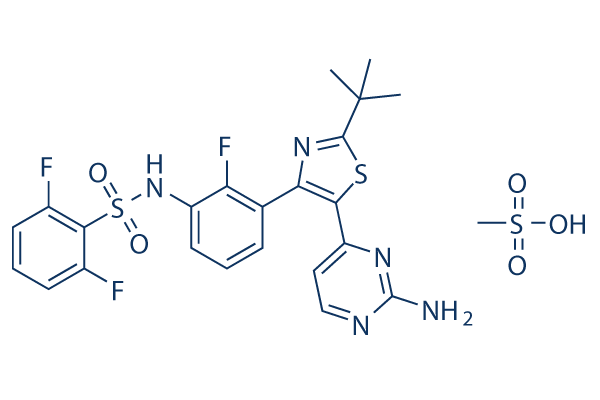
Dabrafenib Mesylate Raf inhibitor
Cat.No.S5069
Quality Control
| Related Targets | ERK p38 MAPK JNK MEK Ras KRas S6 Kinase MAP4K TAK1 Mixed Lineage Kinase |
|---|---|
| Other Raf Inhibitors | LY3009120 Exarafenib (KIN-2787) GDC-0879 Avutometinib (Ro5126766, CH5126766) PLX-4720 AZ 628 SB590885 TAK-632 GW5074 RAF265 (CHIR-265) |
Solubility
|
In vitro |
DMSO
: 100 mg/mL
(162.42 mM)
Water : Insoluble Ethanol : Insoluble |
Molarity Calculator
|
In vivo |
|||||
In vivo Formulation Calculator (Clear solution)
Step 1: Enter information below (Recommended: An additional animal making an allowance for loss during the experiment)
Step 2: Enter the in vivo formulation (This is only the calculator, not formulation. Please contact us first if there is no in vivo formulation at the solubility Section.)
Calculation results:
Working concentration: mg/ml;
Method for preparing DMSO master liquid: mg drug pre-dissolved in μL DMSO ( Master liquid concentration mg/mL, Please contact us first if the concentration exceeds the DMSO solubility of the batch of drug. )
Method for preparing in vivo formulation: Take μL DMSO master liquid, next addμL PEG300, mix and clarify, next addμL Tween 80, mix and clarify, next add μL ddH2O, mix and clarify.
Method for preparing in vivo formulation: Take μL DMSO master liquid, next add μL Corn oil, mix and clarify.
Note: 1. Please make sure the liquid is clear before adding the next solvent.
2. Be sure to add the solvent(s) in order. You must ensure that the solution obtained, in the previous addition, is a clear solution before proceeding to add the next solvent. Physical methods such
as vortex, ultrasound or hot water bath can be used to aid dissolving.
Chemical Information, Storage & Stability
| Molecular Weight | 615.67 | Formula | C23H20F3N5O2S2.CH4O3S |
Storage (From the date of receipt) | 3 years -20°C powder |
|---|---|---|---|---|---|
| CAS No. | 1195768-06-9 | -- | Storage of Stock Solutions |
|
|
| Synonyms | GSK2118436 Mesylate | SMILES | CC(C)(C)C1=NC(=C(S1)C2=NC(=NC=C2)N)C3=C(C(=CC=C3)NS(=O)(=O)C4=C(C=CC=C4F)F)F.CS(=O)(=O)O | ||
Read more about storage stability stock solution CAS number SMILES
Mechanism of Action
| Targets/IC50/Ki |
B-Raf (V600E)
(Cell-free assay) 0.7 nM
B-Raf
(Cell-free assay) 5.2 nM
C-Raf
(Cell-free assay) 6.3 nM
|
|---|---|
| In vitro |
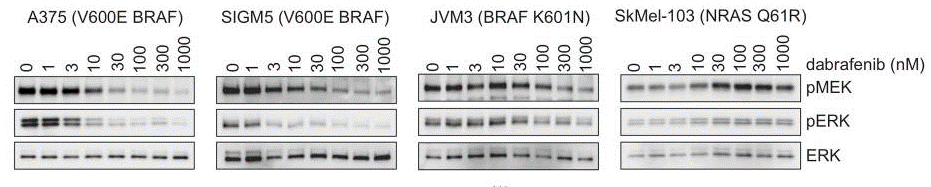
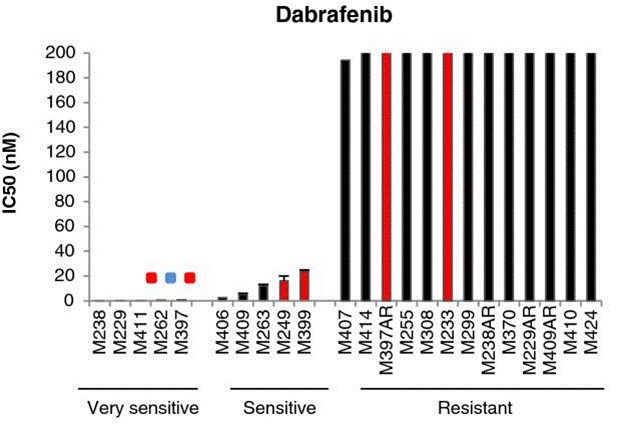
Dabrafenib displayed compelling inhibitory activity in enzyme and cellular mechanistic assays, and in cell proliferation assays in B-RafV600E-driven melanoma lines, SKMEL28 and A375P F11 (IC50 = 3 and 8 nM, respectively), and colorectal carcinoma line Colo205 (IC50 = 7 nM). Dabrafenib has a minimal effect in vitro on cells with wild-type B-Raf (HFF IC50 = 3.0 μM) and in tumor cells not harboring the activating B-RafV600E mutation. It is highly selective, exhibiting >500-fold selectivity for B-RafV600E compared to most kinases screened. Significant activity (<100-fold selectivity) was observed for a single kinase in the panel, Alk5. GSK2118436 is significantly less effective at inhibiting SMAD2/3 phosphorylation (IC50 = 3.7 μM) compared with inhibiting ERK phosphorylation (IC50 = 4 nM) in a cellular context. Cellular inhibition of BRAFV600E kinase activity by dabrafenib resulted in decreased MEK and ERK phosphorylation and inhibition of cell proliferation through an initial G1 cell cycle arrest, followed by cell death.
|
| In vivo |
In a BRAFV600E-containing xenograft model of human melanoma, orally administered dabrafenib inhibited ERK activation, downregulated Ki67, and upregulated p27, leading to tumor growth inhibition. Dabrafenib is orally bioavailable, doesn’t significantly accumulate after multiple dosing, and causes a reduction of pERK that is sustained for up to 18 h post-dosing after 7 and 14 days of dosing.
|
References |
|
Applications
| Methods | Biomarkers | Images | PMID |
|---|---|---|---|
| Western blot | pMEK / pERK / ERK p-S6 / p-AKT308 / p-AKT473 β-catenin |
|
31158244 |
| Growth inhibition assay | IC50 |
|
24735930 |
Clinical Trial Information
(data from https://clinicaltrials.gov, updated on 2025-03-26)
| NCT Number | Recruitment | Conditions | Sponsor/Collaborators | Start Date | Phases |
|---|---|---|---|---|---|
| NCT06119789 | RECRUITING | Rare Malignant Neoplasm |
Oslo University Hospital |
2025-03-20 | PHASE2 |
| NCT03340506 | RECRUITING | Melanoma; Non Small Cell Lung Cancer; Solid Tumor; Rare Cancers; High Grade Glioma |
Novartis Pharmaceuticals |
2018-01-26 | PHASE4 |
| NCT07110246 | RECRUITING | BRAF V600 Mutation; Low-grade Glioma; Low Grade Glioma of Brain; Recurrent Low Grade Glioma |
University of California, San Francisco |
2025-11-07 | PHASE2 |
| NCT06475989 | RECRUITING | Refractory Differentiated Thyroid Gland Carcinoma |
ECOG-ACRIN Cancer Research Group |
2024-08-22 | PHASE3 |
| NCT05722886 | RECRUITING | Haematological Malignancy; Solid Tumour |
Cancer Research UK |
2023-03-01 | PHASE2; PHASE3 |
| NCT07440290 | RECRUITING | Haematological Malignancy; Malignant Neoplasm; Lymphoproliferative Disorders; Neoplasms by Histologic Type; Neoplasms by Site; Gastrointestinal Cancer; Non-Melanoma Skin Cancer (NMSC); Langerhans Cell Histiocytosis (LCH); Cancer; Erdheim-Chester Disease; Thyroid Carcinoma, Papillary; Ovarian Neoplasms; Colorectal Neoplasms; Laryngeal Neoplasms; Carcinoma, Non-Small Cell-Lung; Glioma; Multiple Myeloma; Thyroid Carcinoma, Anaplastic; Solid Tumour; Pancreatic Diseases |
Cancer Research UK |
2026-04-01 | PHASE2; PHASE3 |
Read more about Clinical Trials
Tech Support
Tel: +1-832-582-8158 Ext:3
If you have any other enquiries, please leave a message.
Signaling Pathway Map

Products are for research use only. Not for human use. We do not sell to patients.
©Copyright 2013 Selleck Chemicals. All Rights Reserved.