
-
 Australia
-
 Austria
-
 Belgium
-
 Brazil
-
 Canada
-
 China
China
-
 Czech Republic
-
 Denmark
-
 Finland
-
 France
-
 Germany
-
 Greece
-
 Hong Kong
-
 Hungary
-
 Iceland
-
 India
India
-
 Ireland
-
 Israel
-
 Italy
Italy
-
 Japan
Japan
-
 Korea
Korea
-
 Luxembourg
-
 Malaysia
-
 Netherlands
-
 New Zealand
-
 Norway
-
 Poland
-
 Qatar
Qatar
-
 Romania
-
 Saudi Arabia
-
 Singapore
-
 Spain
Spain
-
 Sweden
-
 Switzerland
-
 Taiwan
-
 Turkey
-
 United Kingdom
-
 United States
research use only
Ruxotemitide (LTX 315) Bcl-2 modulator
Cat.No.S8199
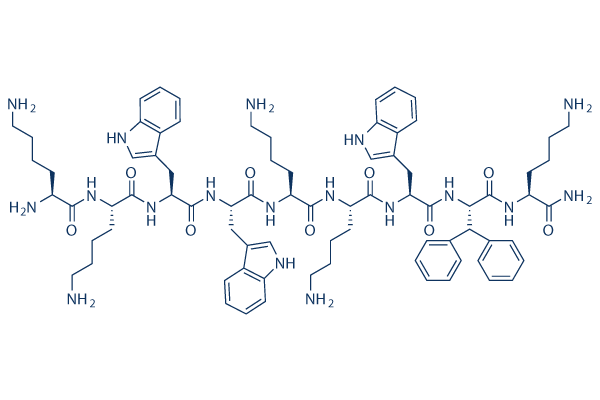
Chemical Structure
Molecular Weight: 1439.79
Quality Control
| Related Targets | Caspase PD-1/PD-L1 Ferroptosis p53 Apoptosis related Synthetic Lethality STAT TNF-alpha Ras KRas |
|---|---|
| Other Bcl-2 Inhibitors | Navitoclax (ABT-263) S63845 ABT-737 Obatoclax Mesylate (GX15-070) A-1331852 A-1210477 TW-37 A-1155463 Dihydrochloride AZD5991 UMI-77 |
Solubility
|
In vitro |
Water : 100 mg/mL |
Molarity Calculator
|
In vivo |
|||||
In vivo Formulation Calculator (Clear solution)
Step 1: Enter information below (Recommended: An additional animal making an allowance for loss during the experiment)
Step 2: Enter the in vivo formulation (This is only the calculator, not formulation. Please contact us first if there is no in vivo formulation at the solubility Section.)
Calculation results:
Working concentration: mg/ml;
Method for preparing DMSO master liquid: mg drug pre-dissolved in μL DMSO ( Master liquid concentration mg/mL, Please contact us first if the concentration exceeds the DMSO solubility of the batch of drug. )
Method for preparing in vivo formulation: Take μL DMSO master liquid, next addμL PEG300, mix and clarify, next addμL Tween 80, mix and clarify, next add μL ddH2O, mix and clarify.
Method for preparing in vivo formulation: Take μL DMSO master liquid, next add μL Corn oil, mix and clarify.
Note: 1. Please make sure the liquid is clear before adding the next solvent.
2. Be sure to add the solvent(s) in order. You must ensure that the solution obtained, in the previous addition, is a clear solution before proceeding to add the next solvent. Physical methods such
as vortex, ultrasound or hot water bath can be used to aid dissolving.
Chemical Information, Storage & Stability
| Molecular Weight | 1439.79 | Formula | C78H106N18O9 |
Storage (From the date of receipt) | |
|---|---|---|---|---|---|
| CAS No. | 1345407-05-7 | Download SDF | Storage of Stock Solutions |
|
|
Mechanism of Action
| In vitro |
LTX-315 is highly active against both murine and human melanoma cell lines in vitro. while displaying low EC50 cytotoxic activity against human red blood cells.
LTX-315 has been shown to induce the release of ATP and HMGB1 in vitro, both being DAMPs involved in ICD.
|
|---|---|
| In vivo |
when syngeneic B16 melanomas are treated intralesionally, a majority of the animals (~80%) treated with LTX-315 experience a complete and long-lasting tumor regression. LTX-315 injection induces an extensive hemorrhagic necrosis of the tumor parenchyma and a massive infiltration of CD3+ T cells, indicating that the peptide induces a type of cell death that leads to an increase in the number of tumor-infiltrating lymphocytes (TILs). treatment of a single tumor with LTX-315 generates a systemic anti-tumor immune response that eradicated distant lesions and prevented reoccurrence following tumor rechallenge.
|
References |
|
Applications
| Methods | Biomarkers | Images | PMID |
|---|---|---|---|
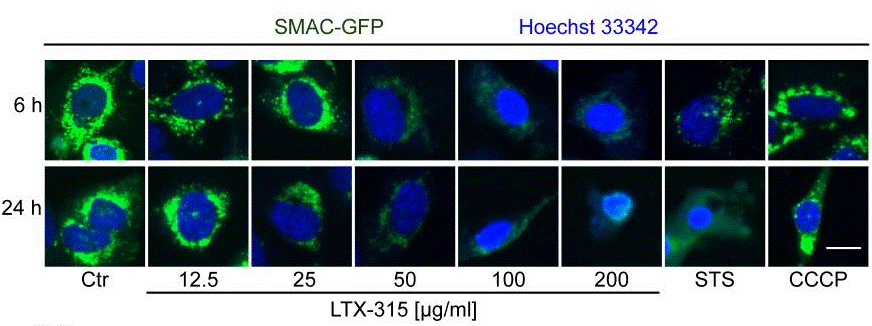
| Immunofluorescence | SMAC BAX |
|
26378049 |
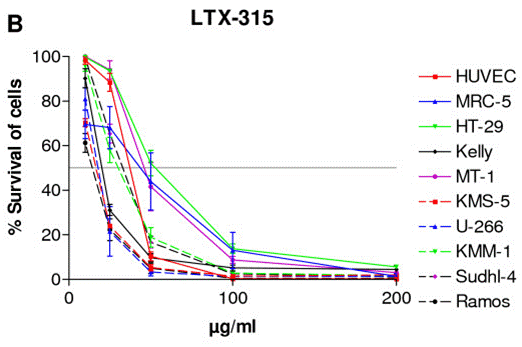
| Growth inhibition assay | Cell viability |
|
21453492 |
Clinical Trial Information
(data from https://clinicaltrials.gov, updated on 2024-05-22)
| NCT Number | Recruitment | Conditions | Sponsor/Collaborators | Start Date | Phases |
|---|---|---|---|---|---|
| NCT03725605 | Completed | Soft Tissue Sarcoma |
Lytix Biopharma AS|Herlev Hospital |
December 28 2018 | Phase 2 |
| NCT01223209 | Completed | Carcinoma |
Lytix Biopharma AS|Kael-GemVax Co. Ltd. |
August 2010 | Phase 1 |
| NCT01058616 | Completed | Cancer With Transdermal Accessible Tumour |
Lytix Biopharma AS|Oslo University Hospital|Karolinska University Hospital |
January 2010 | Phase 1 |
Tech Support
Tel: +1-832-582-8158 Ext:3
If you have any other enquiries, please leave a message.
Signaling Pathway Map

Products are for research use only. Not for human use. We do not sell to patients.
©Copyright 2013 Selleck Chemicals. All Rights Reserved.