
-
 Australia
-
 Austria
-
 Belgium
-
 Brazil
-
 Canada
-
 China
China
-
 Czech Republic
-
 Denmark
-
 Finland
-
 France
-
 Germany
-
 Greece
-
 Hong Kong
-
 Hungary
-
 Iceland
-
 India
India
-
 Ireland
-
 Israel
-
 Italy
Italy
-
 Japan
Japan
-
 Korea
Korea
-
 Luxembourg
-
 Malaysia
-
 Netherlands
-
 New Zealand
-
 Norway
-
 Poland
-
 Qatar
Qatar
-
 Romania
-
 Saudi Arabia
-
 Singapore
-
 Spain
Spain
-
 Sweden
-
 Switzerland
-
 Taiwan
-
 Turkey
-
 United Kingdom
-
 United States
research use only
ON123300 CDK inhibitor
Cat.No.S8161
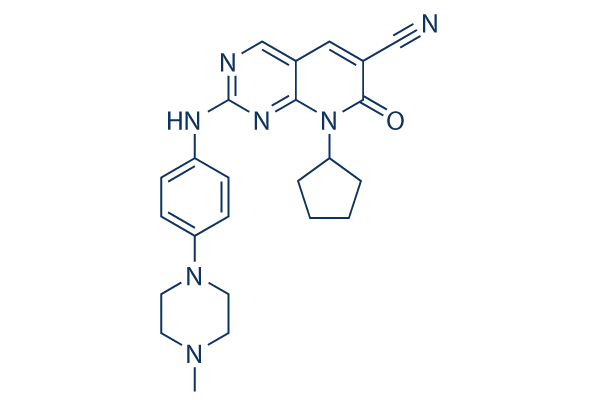
Chemical Structure
Molecular Weight: 429.52
Quality Control
Solubility
|
In vitro |
DMSO
: 29 mg/mL
(67.51 mM)
Water : Insoluble Ethanol : Insoluble |
Molarity Calculator
|
In vivo |
|||||
In vivo Formulation Calculator (Clear solution)
Step 1: Enter information below (Recommended: An additional animal making an allowance for loss during the experiment)
Step 2: Enter the in vivo formulation (This is only the calculator, not formulation. Please contact us first if there is no in vivo formulation at the solubility Section.)
Calculation results:
Working concentration: mg/ml;
Method for preparing DMSO master liquid: mg drug pre-dissolved in μL DMSO ( Master liquid concentration mg/mL, Please contact us first if the concentration exceeds the DMSO solubility of the batch of drug. )
Method for preparing in vivo formulation: Take μL DMSO master liquid, next addμL PEG300, mix and clarify, next addμL Tween 80, mix and clarify, next add μL ddH2O, mix and clarify.
Method for preparing in vivo formulation: Take μL DMSO master liquid, next add μL Corn oil, mix and clarify.
Note: 1. Please make sure the liquid is clear before adding the next solvent.
2. Be sure to add the solvent(s) in order. You must ensure that the solution obtained, in the previous addition, is a clear solution before proceeding to add the next solvent. Physical methods such
as vortex, ultrasound or hot water bath can be used to aid dissolving.
Chemical Information, Storage & Stability
| Molecular Weight | 429.52 | Formula | C24H27N7O |
Storage (From the date of receipt) | |
|---|---|---|---|---|---|
| CAS No. | 1357470-29-1 | Download SDF | Storage of Stock Solutions |
|
|
| Synonyms | N/A | Smiles | CN1CCN(CC1)C2=CC=C(C=C2)NC3=NC=C4C=C(C(=O)N(C4=N3)C5CCCC5)C#N | ||
Mechanism of Action
| Targets/IC50/Ki |
CDK4/CyclinD1
(Cell-free assay) 3.87 nM
ARK5
(Cell-free assay) 4.95 nM
RET
(Cell-free assay) 9.2 nM
CDK6/CyclinD1
(Cell-free assay) 9.82 nM
Fyn
(Cell-free assay) 11 nM
PDGFRβ
(Cell-free assay) 26 nM
FGFR1
(Cell-free assay) 26 nM
PI3Kδ
(Cell-free assay) 144 nM
FGFR1
(Cell-free assay) 260 nM
|
|---|---|
| In vitro |
ON123300 inhibits U87 glioma cell proliferation with an IC50 3.4±0.1 μmol/L and reduces phosphorylation of Akt, yet it also unexpectedly induces Erk activation, both in a dose- and time-dependent manner that subsequently is attributed to relieving Akt mediated C-Raf S259 inactivation and activating a p70S6K-initiated PI3K-negative feedback loop. This compound also inhibits CDK4/6 and PI3K-δ and exhibits potent activity against mantle cell lymphomas (MCLs). It is a potent inhibitor of CDK4, with an IC50 of 3.8 nM, with little inhibitory activity against CDKs 1,2,5 and 8. MCL cell lines treated with this chemical accumulate in the G1 phase at lower concentrations (0.1-1.0μM), at higher concentrations of the compound, a large proportion of the cells progress through the S and G2/M phases of the cell cycle and eventually accumulate in the sub-G1 phase, suggesting an induction of apoptosis. It also inhibits the phosphorylation of pRb and p130 in a dose-dependent manner. This treatment results in inhibition of FOXO1 phosphorylation, a target of mTOR. |
| In vivo |
In a preclinical brain tumor model (U87MG), ON123300 shows high brain and brain tumor accumulation. Consistent with the in vitro studies, single agent this compound causes a dose-dependent suppression of phosphorylation of Akt as well as activation of Erk in brain tumors. It is highly bound (99.4%) to plasma proteins in mice and rapidly penetrates into brain. It has proficient BBB penetration and accumulates in normal brain. The pharmacokinetic profiles of plasma this chemical concentration are multiexponential and overall declines fairly rapidly with terminal elimination half-lives of 1.5 hours. Mouse xenograft assays show a strong inhibition of MCL tumor growth in this compound-treated animals. Safety studies in mice suggest that it is orally bio-available and is minimally toxic when administered orally or intraperitoneally. |
References |
|
Clinical Trial Information
(data from https://clinicaltrials.gov, updated on 2024-05-22)
| NCT Number | Recruitment | Conditions | Sponsor/Collaborators | Start Date | Phases |
|---|---|---|---|---|---|
| NCT06351644 | Not yet recruiting | Relapsed and/or Refractory Multiple Myeloma |
Adriana Rossi|Icahn School of Medicine at Mount Sinai |
June 3 2024 | Phase 1|Phase 2 |
| NCT04739293 | Recruiting | Solid Tumors Adult |
Traws Pharma Inc. |
May 13 2021 | Phase 1 |
Tech Support
Tel: +1-832-582-8158 Ext:3
If you have any other enquiries, please leave a message.
Signaling Pathway Map

Products are for research use only. Not for human use. We do not sell to patients.
©Copyright 2013 Selleck Chemicals. All Rights Reserved.