
-
 Australia
-
 Austria
-
 Belgium
-
 Brazil
-
 Canada
-
 China
China
-
 Czech Republic
-
 Denmark
-
 Finland
-
 France
-
 Germany
-
 Greece
-
 Hong Kong
-
 Hungary
-
 Iceland
-
 India
India
-
 Ireland
-
 Israel
-
 Italy
Italy
-
 Japan
Japan
-
 Korea
Korea
-
 Luxembourg
-
 Malaysia
-
 Netherlands
-
 New Zealand
-
 Norway
-
 Poland
-
 Qatar
Qatar
-
 Romania
-
 Saudi Arabia
-
 Singapore
-
 Spain
Spain
-
 Sweden
-
 Switzerland
-
 Taiwan
-
 Turkey
-
 United Kingdom
-
 United States
research use only
CGI1746 BTK inhibitor
Cat.No.S7051
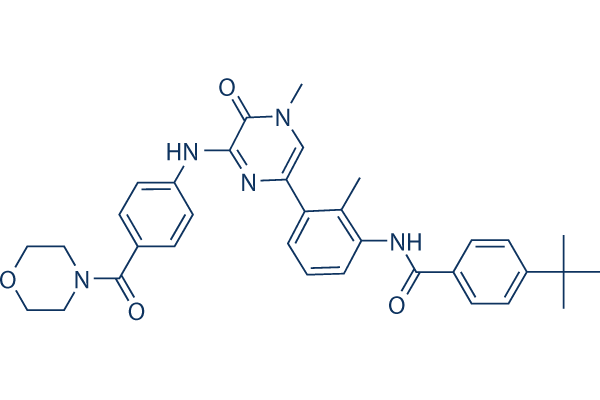
Chemical Structure
Molecular Weight: 579.69
Quality Control
Solubility
|
In vitro |
DMSO
: 250 mg/mL
(431.26 mM)
Ethanol : 33 mg/mL Water : Insoluble |
Molarity Calculator
|
In vivo |
|||||
In vivo Formulation Calculator (Clear solution)
Step 1: Enter information below (Recommended: An additional animal making an allowance for loss during the experiment)
Step 2: Enter the in vivo formulation (This is only the calculator, not formulation. Please contact us first if there is no in vivo formulation at the solubility Section.)
Calculation results:
Working concentration: mg/ml;
Method for preparing DMSO master liquid: mg drug pre-dissolved in μL DMSO ( Master liquid concentration mg/mL, Please contact us first if the concentration exceeds the DMSO solubility of the batch of drug. )
Method for preparing in vivo formulation: Take μL DMSO master liquid, next addμL PEG300, mix and clarify, next addμL Tween 80, mix and clarify, next add μL ddH2O, mix and clarify.
Method for preparing in vivo formulation: Take μL DMSO master liquid, next add μL Corn oil, mix and clarify.
Note: 1. Please make sure the liquid is clear before adding the next solvent.
2. Be sure to add the solvent(s) in order. You must ensure that the solution obtained, in the previous addition, is a clear solution before proceeding to add the next solvent. Physical methods such
as vortex, ultrasound or hot water bath can be used to aid dissolving.
Chemical Information, Storage & Stability
| Molecular Weight | 579.69 | Formula | C34H37N5O4 |
Storage (From the date of receipt) | |
|---|---|---|---|---|---|
| CAS No. | 910232-84-7 | Download SDF | Storage of Stock Solutions |
|
|
| Synonyms | N/A | Smiles | CC1=C(C=CC=C1NC(=O)C2=CC=C(C=C2)C(C)(C)C)C3=CN(C(=O)C(=N3)NC4=CC=C(C=C4)C(=O)N5CCOCC5)C | ||
Mechanism of Action
| Targets/IC50/Ki |
BTK
(Cell-free assay) 1.9 nM
|
|---|---|
| In vitro |
CGI1746 is specific for Btk, with ∼1,000-fold selectivity over Tec and Src family kinases. In an ATP-free competition binding assay, the dissociation constant for Btk is 1.5 nM. This compound inhibits Btk activity in a new binding mode that stabilizes an inactive nonphosphorylated enzyme conformation. It inhibits both auto- and transphosphorylation steps necessary for enzyme activation. This chemical completely inhibits anti-IgM–induced murine and human B cell proliferation, with IC50s of 134 nM and 42 nM, respectively, but had no effect on anti-CD3- and anti-CD28–induced T cell proliferation. It potently inhibits the proliferation of CD27+IgG+ B cells isolated from the tonsils of four human donors with an average IC50 of 112 nM. In macrophages, this compound abolishes FcγRIII-induced TNFα, IL-1β and IL-6 production. It potently inhibits TNFα, IL-1β and, to a lesser extent, IL-6 (three- to eight-fold higher IC50) production in human monocytes stimulated with immobilized or soluble immune complexes.
|
| In vivo |
CGI1746 abrogates B cell–dependent arthritis. This compound treatment (100 mg/kg, s.c, twice-daily dosing) results in significant inhibition (97%) of overall clinical arthritis scores.
This compound treatment substantially reduces TNFα, IL-1β and IL-6, as well as MCP1 and MIP-1α on both the mRNA and protein level in the passive anti-collagen II antibody–induced arthritis (CAIA) model.
This compound shows comparable efficacy to TNFα blockade and significantly reduces clinical scores, as well as joint inflammation, in mice or rats with established arthritis.
|
References |
Tech Support
Tel: +1-832-582-8158 Ext:3
If you have any other enquiries, please leave a message.
Signaling Pathway Map

Products are for research use only. Not for human use. We do not sell to patients.
©Copyright 2013 Selleck Chemicals. All Rights Reserved.