
-
 Argentina
-
 Australia
-
 Austria
-
 Belgium
-
 Brazil
-
 Canada
-
 China
China
-
 Czech Republic
-
 Denmark
-
 Finland
-
 France
-
 Germany
-
 Greece
-
 Hong Kong
-
 Hungary
-
 Iceland
-
 India
India
-
 Ireland
-
 Israel
-
 Italy
Italy
-
 Japan
Japan
-
 Korea
Korea
-
 Luxembourg
-
 Malaysia
-
 Netherlands
-
 New Zealand
-
 Norway
-
 Poland
-
 Portugal
-
 Qatar
Qatar
-
 Romania
-
 Saudi Arabia
-
 Singapore
-
 Spain
Spain
-
 Sweden
-
 Switzerland
-
 Taiwan
-
 Turkey
-
 United Kingdom
-
 United States
research use only
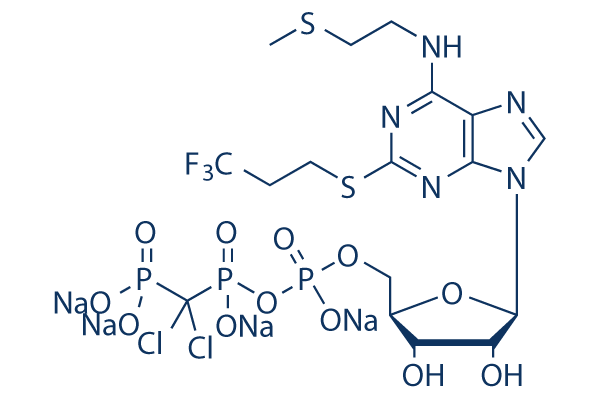
Cangrelor Tetrasodium P2 Receptor inhibitor
Cat.No.S3737
Quality Control
| Related Targets | Adrenergic Receptor AChR 5-HT Receptor COX Calcium Channel Histamine Receptor Dopamine Receptor GABA Receptor TRP Channel Cholinesterase (ChE) |
|---|---|
| Other P2 Receptor Inhibitors | A-438079 Hydrochloride A-804598 MRS 2578 AF-353 A-740003 5-BDBD Aurintricarboxylic acid A-317491 Gefapixant JNJ-47965567 |
Cell Culture, Treatment & Working Concentration
| Cell Lines | Assay Type | Concentration | Incubation Time | Formulation | Activity Description | PMID |
|---|---|---|---|---|---|---|
| 1321N1 | Function assay | 30 mins | Antagonist activity at human GPR17 R255I mutant expressed in human 1321N1 cells assessed as inhibition of UDP-glucose-induced [35S]GTPgammaS binding after 30 mins by rapid filtration assay, IC50=0.00015μM | 20394377 | ||
| 1321N1 | Function assay | 30 mins | Antagonist activity at human GPR17 expressed in human 1321N1 cells assessed as inhibition of UDP-glucose-induced [35S]GTPgammaS binding after 30 mins by rapid filtration assay, IC50=0.0007μM | 20394377 | ||
| Click to View More Cell Line Experimental Data | ||||||
Solubility
|
In vitro |
Water : 100 mg/mL
DMSO
: 2 mg/mL
(2.31 mM)
Ethanol : Insoluble |
Molarity Calculator
|
In vivo |
|||||
In vivo Formulation Calculator (Clear solution)
Step 1: Enter information below (Recommended: An additional animal making an allowance for loss during the experiment)
Step 2: Enter the in vivo formulation (This is only the calculator, not formulation. Please contact us first if there is no in vivo formulation at the solubility Section.)
Calculation results:
Working concentration: mg/ml;
Method for preparing DMSO master liquid: mg drug pre-dissolved in μL DMSO ( Master liquid concentration mg/mL, Please contact us first if the concentration exceeds the DMSO solubility of the batch of drug. )
Method for preparing in vivo formulation: Take μL DMSO master liquid, next addμL PEG300, mix and clarify, next addμL Tween 80, mix and clarify, next add μL ddH2O, mix and clarify.
Method for preparing in vivo formulation: Take μL DMSO master liquid, next add μL Corn oil, mix and clarify.
Note: 1. Please make sure the liquid is clear before adding the next solvent.
2. Be sure to add the solvent(s) in order. You must ensure that the solution obtained, in the previous addition, is a clear solution before proceeding to add the next solvent. Physical methods such
as vortex, ultrasound or hot water bath can be used to aid dissolving.
Chemical Information, Storage & Stability
| Molecular Weight | 864.29 | Formula | 21Cl2F3N5O12P3S2.4Na |
Storage (From the date of receipt) | |
|---|---|---|---|---|---|
| CAS No. | 163706-36-3 | Download SDF | Storage of Stock Solutions |
|
|
| Synonyms | AR-C69931MX | SMILES | CSCCNC1=C2C(=NC(=N1)SCCC(F)(F)F)N(C=N2)C3C(C(C(O3)COP(=O)([O-])OP(=O)(C(P(=O)([O-])[O-])(Cl)Cl)[O-])O)O.[Na+].[Na+].[Na+].[Na+] | ||
Read more about storage stability stock solution CAS number SMILES
Mechanism of Action
| Targets/IC50/Ki |
P2Y12 receptor
|
|---|---|
| In vitro |
Cangrelor is an intravenous ATP analog that directly inhibits, without the need for being metabolized, the P2Y12 receptor in a reversible manner. Cangrelor has a rapid-onset and -offset mechanism of action and achieves significantly greater degrees of platelet inhibition compared with clopidogrel.
|
| In vivo |
Cangrelor is rapidly deactivated by plasmatic ectonucleotidases and, thus, has an extrmely short half-life (2-5 min). Preclinical studies performed in animal models in the early stages of cangrelor development show efficacy in inhibiting thrombus formation and ADP-induced platelet aggregation, as well as a lower increase of bleeding times when compared with IIb/IIIa antagonist.
|
References |
Clinical Trial Information
(data from https://clinicaltrials.gov, updated on 2026-03-02)
| NCT Number | Recruitment | Conditions | Sponsor/Collaborators | Start Date | Phases |
|---|---|---|---|---|---|
| NCT04667078 | RECRUITING | Acute Ischemia |
Fondation Ophtalmologique Adolphe de Rothschild |
2022-03-02 | PHASE3 |
| NCT07225842 | RECRUITING | Coronary Arterial Disease (CAD) |
University of Florida |
2026-02-18 | PHASE4 |
| NCT06792643 | RECRUITING | Cardiogenic Shock; Extracorporeal Membrane Oxygenation Complication; Platelet Dysfunction |
IRCCS San Raffaele |
2024-04-01 | PHASE2 |
| NCT06089577 | RECRUITING | Coronary Artery Disease |
Federico II University |
2023-11-01 | PHASE4 |
| NCT03551964 | COMPLETED | Acute Myocardial Infarction; Cardiogenic Shock |
Faculty Hospital Kralovske Vinohrady |
2018-08-01 | PHASE4 |
| NCT04927949 | COMPLETED | ST-elevation Myocardial Infarction |
University Hospital, Caen |
2021-06-08 | PHASE4 |
Read more about Clinical Trials
Tech Support
Tel: +1-832-582-8158 Ext:3
If you have any other enquiries, please leave a message.
Signaling Pathway Map

Products are for research use only. Not for human use. We do not sell to patients.
©Copyright 2013 Selleck Chemicals. All Rights Reserved.