
-
 Argentina
-
 Australia
-
 Austria
-
 Belgium
-
 Brazil
-
 Canada
-
 China
China
-
 Czech Republic
-
 Denmark
-
 Finland
-
 France
-
 Germany
-
 Greece
-
 Hong Kong
-
 Hungary
-
 Iceland
-
 India
India
-
 Ireland
-
 Israel
-
 Italy
Italy
-
 Japan
Japan
-
 Korea
Korea
-
 Luxembourg
-
 Malaysia
-
 Netherlands
-
 New Zealand
-
 Norway
-
 Poland
-
 Portugal
-
 Qatar
Qatar
-
 Romania
-
 Saudi Arabia
-
 Singapore
-
 Spain
Spain
-
 Sweden
-
 Switzerland
-
 Taiwan
-
 Turkey
-
 United Kingdom
-
 United States
research use only
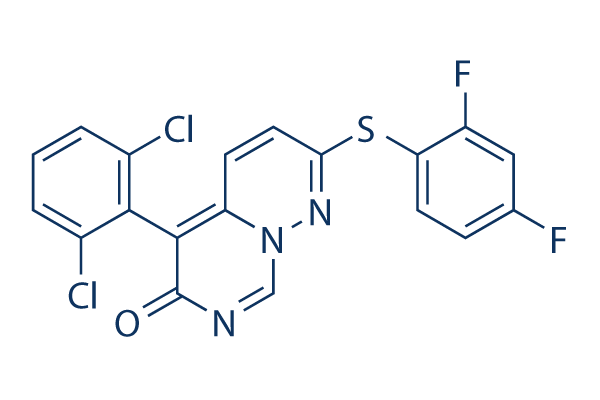
Neflamapimod (VX-745) p38 MAPK inhibitor
Cat.No.S1458
Quality Control
| Related Targets | ERK Raf JNK MEK Ras KRas S6 Kinase MAP4K TAK1 Mixed Lineage Kinase |
|---|---|
| Other p38 MAPK Inhibitors | SB202190 SB203580 (Adezmapimod) PH-797804 Doramapimod (BIRB 796) Ralimetinib (LY2228820) dimesylate VX-702 Losmapimod SB239063 Asiatic Acid BMS-582949 |
Solubility
|
In vitro |
DMSO
: 15 mg/mL
(34.38 mM)
Water : Insoluble Ethanol : Insoluble |
Molarity Calculator
|
In vivo |
|||||
In vivo Formulation Calculator (Clear solution)
Step 1: Enter information below (Recommended: An additional animal making an allowance for loss during the experiment)
Step 2: Enter the in vivo formulation (This is only the calculator, not formulation. Please contact us first if there is no in vivo formulation at the solubility Section.)
Calculation results:
Working concentration: mg/ml;
Method for preparing DMSO master liquid: mg drug pre-dissolved in μL DMSO ( Master liquid concentration mg/mL, Please contact us first if the concentration exceeds the DMSO solubility of the batch of drug. )
Method for preparing in vivo formulation: Take μL DMSO master liquid, next addμL PEG300, mix and clarify, next addμL Tween 80, mix and clarify, next add μL ddH2O, mix and clarify.
Method for preparing in vivo formulation: Take μL DMSO master liquid, next add μL Corn oil, mix and clarify.
Note: 1. Please make sure the liquid is clear before adding the next solvent.
2. Be sure to add the solvent(s) in order. You must ensure that the solution obtained, in the previous addition, is a clear solution before proceeding to add the next solvent. Physical methods such
as vortex, ultrasound or hot water bath can be used to aid dissolving.
Chemical Information, Storage & Stability
| Molecular Weight | 436.26 | Formula | C19H9Cl2F2N3OS |
Storage (From the date of receipt) | |
|---|---|---|---|---|---|
| CAS No. | 209410-46-8 | Download SDF | Storage of Stock Solutions |
|
|
| Synonyms | N/A | SMILES | C1=CC(=C(C(=C1)Cl)C2=C3C=CC(=NN3C=NC2=O)SC4=C(C=C(C=C4)F)F)Cl | ||
Read more about storage stability stock solution CAS number SMILES
Mechanism of Action
| Features |
A potent and selective inhibitor to p38α and p38β MAPK.
|
|---|---|
| Targets/IC50/Ki |
p38α
10 nM
p38β
220 nM
|
| In vitro |
Neflamapimod (VX-745) selectively inhibits p38α and p38β MAPK with IC50 of 10 nM and 220 nM, respectively, but not p38γ MAPK and a large panel of other kinases, with IC50 larger than 20 µM. In a human peripheral blood mononuclear cell (PBMC) assay, it provides IC50 of 56 and 52 nM for IL-1β and TNFα, respectively. This compound blocks IL-6 and IL-8 production induced by IL-1 and TNFα, and COX-2 synthesis mediated by LPS and IL-1β.
At concentrations of 60 nM-20 µM, it inhibits IL-6 and VEGF secretion in bone marrow stromal cells (BMSCs), without affecting their viability. It also inhibits TNF-α-induced IL-6 secretion in BMSCs. Furthermore, it inhibits both multiple myeloma (MM) cell proliferation and IL-6 secretion in BMSCs triggered by adherence of MM cells to BMSCs, suggesting that VX-745 can inhibit paracrine multiple myeloma (MM) cell growth in the BM milieu and overcome cell adhesion-related drug resistance.
|
| Kinase Assay |
Spectrophotometric coupled-enzyme assay
|
|
Neflamapimod (VX-745) 的 IC50 值通过分光光度法偶联酶测定获得,用于抑制 p38α 和 p38β 同源蛋白。将固定浓度的酶(15 nM p38α 或 p38β)与该化合物在 DMSO 中于 30 °C 孵育 10 分钟,缓冲液为 0.1 M HEPES(pH 7.5),含 10% 甘油、10 mM MgCl2、2.5 mM 磷酸烯醇丙酮酸、200 µM NADH、150 µg/mL 丙酮酸激酶、50 µg/mL 乳酸脱氢酶和 200 µM EGF 受体肽(KRELVEPLTPSGEAPNQALLR)。反应分别通过加入 100 µM(p38α 测定)和 70 µM(p38β 测定)的 ATP 启动。通过监测 340 nm 处吸光度的降低来跟踪反应速率,IC50 值根据速率数据随该抑制剂浓度的函数关系评估得出。
|
|
| In vivo |
Neflamapimod (VX-745) is effective against adjuvant-induced arthritis (AA) in the rat with ED50 of 5 mg/kg. Histological scores for this compound in AA rats are 93% inhibition of bone resorption and 56% inhibition of inflammation. In the classical cartilage-induced arthritis model, it exhibits a dose-responsive decrease in severity score.
In a type II collagen-induced arthritis (CIA) mice model, VX-745 (2.5, 5, and 10 mg/kg) has 27%, 31%, and 44% improvement in the inflammatory scores, respectively, when compared to vehicle-treated mice. In addition, histological scores show a 32-39% protection of bone and cartilage erosion by it.
|
References |
|
Clinical Trial Information
(data from https://clinicaltrials.gov, updated on 2026-07-08)
| NCT Number | Recruitment | Conditions | Sponsor/Collaborators | Start Date | Phases |
|---|---|---|---|---|---|
| NCT06987643 | ACTIVE_NOT_RECRUITING | Moderate to Severe Acute Ischaemic Stroke; Ischaemic Stroke |
EIP Pharma Inc |
2025-06-20 | PHASE2 |
| NCT07033481 | ACTIVE_NOT_RECRUITING | Nonfluent Variant Primary Progressive Aphasia (nfvPPA) |
EIP Pharma Inc |
2025-10-02 | PHASE2 |
| NCT06815965 | COMPLETED | Dementia With Lewy Bodies (DLB) |
EIP Pharma Inc |
2024-10-16 | PHASE2 |
| NCT05869669 | COMPLETED | Dementia With Lewy Bodies |
EIP Pharma Inc |
2023-05-01 | PHASE2 |
| NCT03435861 | COMPLETED | Alzheimer Disease |
University Hospital, Toulouse |
2018-10-08 | PHASE2 |
| NCT03980938 | TERMINATED | Huntington Disease |
EIP Pharma Inc |
2019-07-08 | PHASE2 |
Read more about Clinical Trials
Tech Support
Tel: +1-832-582-8158 Ext:3
If you have any other enquiries, please leave a message.
Signaling Pathway Map

Products are for research use only. Not for human use. We do not sell to patients.
©Copyright 2013 Selleck Chemicals. All Rights Reserved.