
-
 Australia
-
 Austria
-
 Belgium
-
 Brazil
-
 Canada
-
 China
China
-
 Czech Republic
-
 Denmark
-
 Finland
-
 France
-
 Germany
-
 Greece
-
 Hong Kong
-
 Hungary
-
 Iceland
-
 India
India
-
 Ireland
-
 Israel
-
 Italy
Italy
-
 Japan
Japan
-
 Korea
Korea
-
 Luxembourg
-
 Malaysia
-
 Netherlands
-
 New Zealand
-
 Norway
-
 Poland
-
 Qatar
Qatar
-
 Romania
-
 Saudi Arabia
-
 Singapore
-
 Spain
Spain
-
 Sweden
-
 Switzerland
-
 Taiwan
-
 Turkey
-
 United Kingdom
-
 United States
research use only
SC144 GP130 Inhibitor
Cat.No.S7124
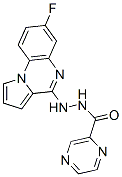
Chemical Structure
Molecular Weight: 322.3
Quality Control
| Related Targets | PD-1/PD-L1 CXCR STING AhR Immunology & Inflammation related CD markers Anti-infection Antioxidant COX Histamine Receptor |
|---|---|
| Other Interleukins Inhibitors | Ossirene (AS101) Diacerein Ac-YVAD-cmk Apilimod mesylate EC330 Sodium Thiocyanate IQ 3 Raleukin Cp2-SO4 Suplatast Tosylate |
Cell Culture, Treatment & Working Concentration
| Cell Lines | Assay Type | Concentration | Incubation Time | Formulation | Activity Description | PMID |
|---|---|---|---|---|---|---|
| LNCap cells | Cytotoxicity assay | 72 h | Cytotoxicity against human LNCap cells after 72 hrs by MTT assay, IC50=0.4 μM | 17085054 | ||
| HCT116 cells | Cytotoxicity assay | 72 h | Cytotoxicity against human HCT116 cells expressing p53 gene after 72 hrs by MTT assay, IC50=0.6 μM | 17085054 | ||
| HT29 cells | Cytotoxicity assay | 72 h | Cytotoxicity against human HT29 cells after 72 hrs by MTT assay, IC50=0.9 μM | 17085054 | ||
| HCT116 cells | Cytotoxicity assay | 72 h | Cytotoxicity against p53 deficient human HCT116 cells after 72 hrs by MTT assay, IC50=0.9 μM | 17085054 | ||
| MDA-MB-435 cells | Cytotoxicity assay | 72 h | Cytotoxicity against human MDA-MB-435 cells after 72 hrs by MTT assay, IC50=4 μM | 17085054 | ||
| Click to View More Cell Line Experimental Data | ||||||
Solubility
|
In vitro |
DMSO
: 64 mg/mL
(198.57 mM)
Water : Insoluble Ethanol : Insoluble |
Molarity Calculator
|
In vivo |
|||||
In vivo Formulation Calculator (Clear solution)
Step 1: Enter information below (Recommended: An additional animal making an allowance for loss during the experiment)
Step 2: Enter the in vivo formulation (This is only the calculator, not formulation. Please contact us first if there is no in vivo formulation at the solubility Section.)
Calculation results:
Working concentration: mg/ml;
Method for preparing DMSO master liquid: mg drug pre-dissolved in μL DMSO ( Master liquid concentration mg/mL, Please contact us first if the concentration exceeds the DMSO solubility of the batch of drug. )
Method for preparing in vivo formulation: Take μL DMSO master liquid, next addμL PEG300, mix and clarify, next addμL Tween 80, mix and clarify, next add μL ddH2O, mix and clarify.
Method for preparing in vivo formulation: Take μL DMSO master liquid, next add μL Corn oil, mix and clarify.
Note: 1. Please make sure the liquid is clear before adding the next solvent.
2. Be sure to add the solvent(s) in order. You must ensure that the solution obtained, in the previous addition, is a clear solution before proceeding to add the next solvent. Physical methods such
as vortex, ultrasound or hot water bath can be used to aid dissolving.
Chemical Information, Storage & Stability
| Molecular Weight | 322.3 | Formula | C16H11FN6O |
Storage (From the date of receipt) | |
|---|---|---|---|---|---|
| CAS No. | 895158-95-9 | Download SDF | Storage of Stock Solutions |
|
|
| Synonyms | N/A | Smiles | C1=CN2C3=C(C=C(C=C3)F)N=C(C2=C1)NNC(=O)C4=NC=CN=C4 | ||
Mechanism of Action
| Targets/IC50/Ki |
gp130
|
|---|---|
| In vitro |
SC144 exhibits potent cytotoxicity against a panel of drug-sensitive and drug-resistant cancer cell lines. This compound shows synergism when co-treated in colorectal cancer HT29 cells. In addition, the combination of this chemical exhibited synergism in MDA-MB-435 cells with a schedule-dependent block in cell cycle. Its treatment in vitro induces gp130 phosphorylation and deglycosylation, resulting in the downregulation of surface-bound gp130 and the abrogation of gp130-associated Stat3 activation. In addition, it selectively inhibits the downstream signaling activation induced by gp130 substrates, including IL-6 and LIF. Protein expression regulated by the gp130/Stat3 axis in OVCAR-8 cells is also down-regulated after this treatment, including Bcl-2, Bcl-XL, survivin, cyclin D1, MMP-7, gp130 and Ape1/Rel-1. |
| In vivo |
SC144 significantly inhibits tumor growth in a mouse xenograft model of human ovarian cancer via i.p. or p.o. administration. After this compound treatment for two months, gp130, Bcl-2, Bcl-XL, MMP-7 and Ape1/Ref-1 protein levels are substantially decreased in the tumor site in the treatment group compared with the control group. In an MDA-MB-435 mouse xenograft model, co-administration of this chemical delays tumor growth in an SC144 dose-dependent manner. Evaluation of the pharmacokinetics of this compound reveals that intraperitoneal administration of this compound shows a two-compartmental pharmacokinetics elimination profile that is not observed in the oral dosing. |
References |
|
Tech Support
Tel: +1-832-582-8158 Ext:3
If you have any other enquiries, please leave a message.

Products are for research use only. Not for human use. We do not sell to patients.
©Copyright 2013 Selleck Chemicals. All Rights Reserved.