
-
 Australia
-
 Austria
-
 Belgium
-
 Brazil
-
 Canada
-
 China
China
-
 Czech Republic
-
 Denmark
-
 Finland
-
 France
-
 Germany
-
 Greece
-
 Hong Kong
-
 Hungary
-
 Iceland
-
 India
India
-
 Ireland
-
 Israel
-
 Italy
Italy
-
 Japan
Japan
-
 Korea
Korea
-
 Luxembourg
-
 Malaysia
-
 Netherlands
-
 New Zealand
-
 Norway
-
 Poland
-
 Qatar
Qatar
-
 Romania
-
 Saudi Arabia
-
 Singapore
-
 Spain
Spain
-
 Sweden
-
 Switzerland
-
 Taiwan
-
 Turkey
-
 United Kingdom
-
 United States
research use only
Obeticholic Acid (INT-747) FXR agonist
Cat.No.S7660
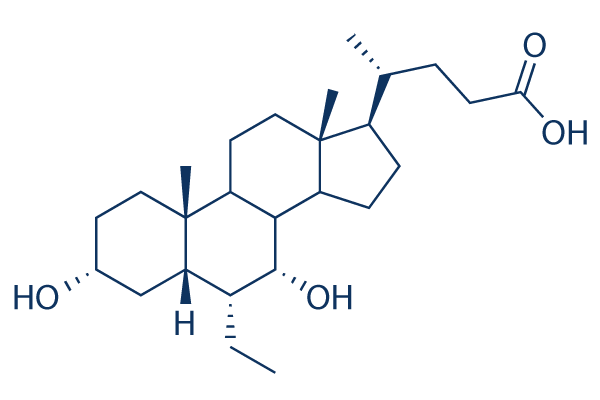
Chemical Structure
Molecular Weight: 420.63
Quality Control
Cell Culture, Treatment & Working Concentration
| Cell Lines | Assay Type | Concentration | Incubation Time | Formulation | Activity Description | PMID |
|---|---|---|---|---|---|---|
| insect cells | Function assay | 1 hr | Agonist activity at recombinant human GST-tagged FXR ligand binding domain (193 to 472 residues) expressed in baculovirus infected insect cells assessed as induction of interaction with biotin labelled SRC-1 after 1 hr by HTRF assay, EC50 = 0.01 μM. | 29148806 | ||
| HEK293T | Function assay | 24 hrs | Agonist activity at human FXR expressed in HEK293T cells assessed as BSEP promoter driven cellular transcriptional activity after 24 hrs by luciferase reporter gene assay, EC50 = 0.042 μM. | 29148806 | ||
| COS1 | Function assay | Agonist activity at FXR expressed in COS1 cells by cell-based bioluminescence assay, EC50 = 0.099 μM. | 20014870 | |||
| HeLa | Function assay | 24 hrs | Agonist activity at human full length FXR expressed in HeLa cells cotransfected with pSG5-human RXR after 24 hrs by Dual-Glo luciferase reporter gene assay, EC50 = 0.16 μM. | 25934227 | ||
| HeLa | Function assay | Agonist activity at human FXR expressed in human HeLa cells assessed as receptor activation by BSEP promoter-driven firefly luciferase reporter gene assay, EC50 = 0.16 μM. | 25255039 | |||
| insect cells | Function assay | 1 hr | Agonist activity at recombinant human GST-tagged FXR LBD (193 to 472 residues) expressed in baculovirus-infected insect cells assessed as recruitment of biotinylated SRC1 peptide measured after 1 hr by Alphascreen assay, EC50 = 0.18 μM. | 29259742 | ||
| COS1 | Function assay | 5 hrs | Agonist activity at human FXR expressed in COS1 cells after 5 hrs by CRE-driven luciferase reporter gene assay, EC50 = 0.361 μM. | 17685603 | ||
| CHO | Function assay | 5 hrs | Agonist activity at human TGR5 expressed in CHO cells after 5 hrs by CRE-driven luciferase reporter gene assay, EC50 = 0.755 μM. | 17685603 | ||
| HEK293 | Function assay | 1 hr | Agonist activity at human TGR5 expressed in HEK293 cells assessed as increase in intracellular cAMP level after 1 hr by TR-FRET assay, EC50 = 0.84 μM. | 29259742 | ||
| NCI-H716 | Function assay | Agonist activity at human TGR5 receptor expressed in NCI-H716 cells assessed as intracellular cAMP level by TR-FRET assay, EC50 = 20 μM. | 21459580 | |||
| HepG2 | Function assay | 20 uM | Induction of FXR-mediated SHP mRNA expression in human HepG2 cells at 20 uM by RT-PCR | 21459580 | ||
| HepG2 | Function assay | 1 uM | Induction of FXR-mediated SHP mRNA expression in human HepG2 cells at 1 uM by RT-PCR | 21459580 | ||
| HepG2 | Function assay | 20 uM | Induction of FXR-mediated BSEP mRNA expression in human HepG2 cells at 20 uM by RT-PCR | 21459580 | ||
| HepG2 | Function assay | 20 uM | Induction of FXR-mediated Ostbeta mRNA expression in human HepG2 cells at 20 uM by RT-PCR | 21459580 | ||
| HepG2 | Function assay | 1 uM | Induction of FXR-mediated down-regulation of Cyp7A1 mRNA expression in human HepG2 cells at 1 uM by RT-PCR | 21459580 | ||
| HepG2 | Function assay | 20 uM | Induction of FXR-mediated down-regulation of Cyp7A1 mRNA expression in human HepG2 cells at 20 uM by RT-PCR | 21459580 | ||
| HepG2 | Function assay | 20 uM | Agonist activity at human FXR expressed in HepG2 cells assessed as renilla luciferase activity at 20 uM by luciferase based transactivation assay | 21459580 | ||
| HepG2 | Function assay | 1 uM | Induction of FXR-mediated BSEP mRNA expression in human HepG2 cells at 1 uM by RT-PCR | 21459580 | ||
| HepG2 | Function assay | 1 uM | Induction of FXR-mediated Ostbeta mRNA expression in human HepG2 cells at 1 uM by RT-PCR | 21459580 | ||
| HepG2 | Function assay | 10 uM | Transactivation of human FXR transfected in human HepG2 cells at 10 uM by beta-galactosidase reporter gene assay | 24387325 | ||
| HepG2 | Function assay | 10 uM | 18 hrs | Agonist activity at FXR in human HepG2 cells assessed as upregulation of OST-alpha mRNA expression at 10 uM after 18 hrs by RT-PCR analysis | 24387325 | |
| GLUTag | Function assay | Agonist activity at GP-BAR1 in mouse GLUTag cells assessed as increase in intracellular cAMP level | 24387325 | |||
| HepG2 | Function assay | 10 uM | 18 hrs | Agonist activity at FXR in human HepG2 cells assessed as upregulation of SHP mRNA expression at 10 uM after 18 hrs by RT-PCR analysis | 24387325 | |
| HepG2 | Function assay | 10 uM | 18 hrs | Agonist activity at FXR in human HepG2 cells assessed as upregulation of BESP mRNA expression at 10 uM after 18 hrs by RT-PCR analysis | 24387325 | |
| GLUTag | Function assay | Agonist activity at GP-BAR1 in mouse GLUTag cells assessed as increase in GLP-1 release | 24387325 | |||
| Click to View More Cell Line Experimental Data | ||||||
Solubility
|
In vitro |
DMSO
: 84 mg/mL
(199.7 mM)
Ethanol : 84 mg/mL Water : Insoluble |
Molarity Calculator
|
In vivo |
|||||
In vivo Formulation Calculator (Clear solution)
Step 1: Enter information below (Recommended: An additional animal making an allowance for loss during the experiment)
Step 2: Enter the in vivo formulation (This is only the calculator, not formulation. Please contact us first if there is no in vivo formulation at the solubility Section.)
Calculation results:
Working concentration: mg/ml;
Method for preparing DMSO master liquid: mg drug pre-dissolved in μL DMSO ( Master liquid concentration mg/mL, Please contact us first if the concentration exceeds the DMSO solubility of the batch of drug. )
Method for preparing in vivo formulation: Take μL DMSO master liquid, next addμL PEG300, mix and clarify, next addμL Tween 80, mix and clarify, next add μL ddH2O, mix and clarify.
Method for preparing in vivo formulation: Take μL DMSO master liquid, next add μL Corn oil, mix and clarify.
Note: 1. Please make sure the liquid is clear before adding the next solvent.
2. Be sure to add the solvent(s) in order. You must ensure that the solution obtained, in the previous addition, is a clear solution before proceeding to add the next solvent. Physical methods such
as vortex, ultrasound or hot water bath can be used to aid dissolving.
Chemical Information, Storage & Stability
| Molecular Weight | 420.63 | Formula | C26H44O4 |
Storage (From the date of receipt) | |
|---|---|---|---|---|---|
| CAS No. | 459789-99-2 | Download SDF | Storage of Stock Solutions |
|
|
| Synonyms | 6-ECDCA, 6-Ethylchenodeoxycholic acid | Smiles | CCC1C2CC(CCC2(C3CCC4(C(C3C1O)CCC4C(C)CCC(=O)O)C)C)O | ||
Mechanism of Action
| Targets/IC50/Ki |
FXR
99 nM(EC50)
|
|---|---|
| In vitro |
In HuH7 cells, Obeticholic Acid (INT-747) acts as a potent FXR agonist with EC50 of 85 nM. |
| Kinase Assay |
Binding Potency of Obeticholic Acid to FXR
|
|
Obeticholic Acid (INT-747) was tested in an established cell-free ligand sensing assay, which measures the ligand-dependent recruitment of an SRC1 peptide to FXR by fluorescence resonance energy transfer.
|
|
| In vivo |
In rat cholestasis model, Obeticholic Acid (INT-747) promotes bile flow and protects hepatocytes against acute necrosis caused by LCA. This compound (p.o.) improves proteinuria, ameliorates renal structural changes, and modulates renal inflammation and oxidative stress in WD-fed DBA mice. In thioacetamide (TAA)-intoxicated and bile-duct-ligated (BDL) rats, it (30 mg/kg p.o.) reactivates the FXR downstream signaling pathway and decreases portal pressure by lowering total IHVR without deleterious systemic hypotension. |
References |
|
Applications
| Methods | Biomarkers | Images | PMID |
|---|---|---|---|
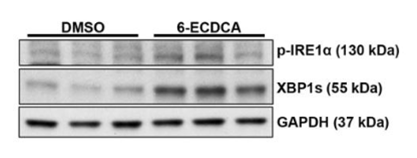
| Western blot | p-IRE1α XBP1s |
|
29377207 |
Clinical Trial Information
(data from https://clinicaltrials.gov, updated on 2024-05-22)
| NCT Number | Recruitment | Conditions | Sponsor/Collaborators | Start Date | Phases |
|---|---|---|---|---|---|
| NCT05740631 | Recruiting | Healthy |
Universitaire Ziekenhuizen KU Leuven|Intercept Pharmaceuticals |
August 22 2022 | Not Applicable |
| NCT02633956 | Completed | Nonalcoholic Steatohepatitis |
Intercept Pharmaceuticals |
December 4 2015 | Phase 2 |
| NCT02548351 | Terminated | Non Alcoholic Steatohepatitis (NASH) |
Intercept Pharmaceuticals |
September 22 2015 | Phase 3 |
Tech Support
Tel: +1-832-582-8158 Ext:3
If you have any other enquiries, please leave a message.
Frequently Asked Questions
Question 1:
What formulation can we use to dissolve it for mice in vivo study?
Answer:
You can use the vehicle of: 1% wt/vol methyl-cellulose as indicated in this paper, http://www.sciencedirect.com/science/article/pii/S0925443911000883 "daily oral gavage with 5 mg/kg/day of this compound or vehicle (1% wt/vol methyl-cellulose) from 3 days prior to induction of colitis"

Products are for research use only. Not for human use. We do not sell to patients.
©Copyright 2013 Selleck Chemicals. All Rights Reserved.