
-
 Argentina
-
 Australia
-
 Austria
-
 Belgium
-
 Brazil
-
 Canada
-
 China
China
-
 Czech Republic
-
 Denmark
-
 Finland
-
 France
-
 Germany
-
 Greece
-
 Hong Kong
-
 Hungary
-
 Iceland
-
 India
India
-
 Ireland
-
 Israel
-
 Italy
Italy
-
 Japan
Japan
-
 Korea
Korea
-
 Luxembourg
-
 Malaysia
-
 Netherlands
-
 New Zealand
-
 Norway
-
 Poland
-
 Portugal
-
 Qatar
Qatar
-
 Romania
-
 Saudi Arabia
-
 Singapore
-
 Spain
Spain
-
 Sweden
-
 Switzerland
-
 Taiwan
-
 Turkey
-
 United Kingdom
-
 United States
research use only
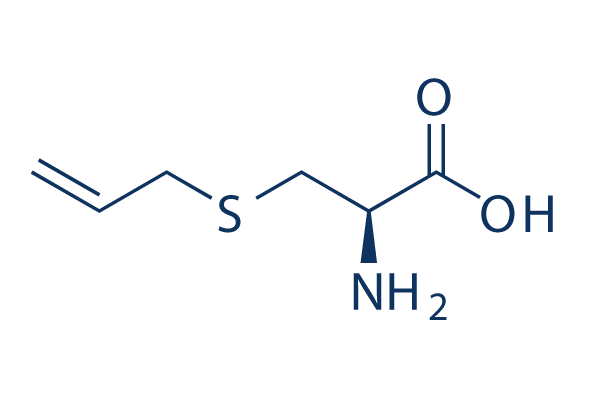
S-allyl-L-cysteine
Cat.No.S4791
Quality Control
Solubility
|
In vitro |
Water : 32 mg/mL
DMSO
: 4 mg/mL
(24.81 mM)
Ethanol : Insoluble |
Molarity Calculator
|
In vivo |
|||||
In vivo Formulation Calculator (Clear solution)
Step 1: Enter information below (Recommended: An additional animal making an allowance for loss during the experiment)
Step 2: Enter the in vivo formulation (This is only the calculator, not formulation. Please contact us first if there is no in vivo formulation at the solubility Section.)
Calculation results:
Working concentration: mg/ml;
Method for preparing DMSO master liquid: mg drug pre-dissolved in μL DMSO ( Master liquid concentration mg/mL, Please contact us first if the concentration exceeds the DMSO solubility of the batch of drug. )
Method for preparing in vivo formulation: Take μL DMSO master liquid, next addμL PEG300, mix and clarify, next addμL Tween 80, mix and clarify, next add μL ddH2O, mix and clarify.
Method for preparing in vivo formulation: Take μL DMSO master liquid, next add μL Corn oil, mix and clarify.
Note: 1. Please make sure the liquid is clear before adding the next solvent.
2. Be sure to add the solvent(s) in order. You must ensure that the solution obtained, in the previous addition, is a clear solution before proceeding to add the next solvent. Physical methods such
as vortex, ultrasound or hot water bath can be used to aid dissolving.
Chemical Information, Storage & Stability
| Molecular Weight | 161.22 | Formula | C6H11NO2S |
Storage (From the date of receipt) | |
|---|---|---|---|---|---|
| CAS No. | 21593-77-1 | Download SDF | Storage of Stock Solutions |
|
|
| Synonyms | S-Allylcysteine | SMILES | C=CCSCC(C(=O)O)N | ||
Read more about storage stability stock solution CAS number SMILES
Mechanism of Action
| In vitro |
S-Allyl cysteine (SAC) could suppress NF-κB activation and lower nitric oxide (NO) production in interferon-γ-stimulated RAW264.7 cells. SAC is known for its anti-apoptotic and antioxidant effects in a range of types of somatic cells. SAC manifests antioxidant properties for example in the nervous and cardiovascular systems.
|
|---|---|
| In vivo |
SAC significantly prevents NSAID-induced gastric ulceration by blocking inflammation. The dietary intake of SAC suppresses protein expression of NF-κB, MAPK, and PKC in kidney of diabetic mice, which in turn declines renal activity and mRNA expression of NOS and COX-2, finally lowers the formation of ROS, nitric oxide, IL-6, TNF-α, and PGE2, as well as improves renal functions. Therefore, SAC is potent anti-inflammatory agents against diabetic nephropathy.
|
References |
|
Tech Support
Tel: +1-832-582-8158 Ext:3
If you have any other enquiries, please leave a message.

Products are for research use only. Not for human use. We do not sell to patients.
©Copyright 2013 Selleck Chemicals. All Rights Reserved.