
-
 Australia
-
 Austria
-
 Belgium
-
 Brazil
-
 Canada
-
 China
China
-
 Czech Republic
-
 Denmark
-
 Finland
-
 France
-
 Germany
-
 Greece
-
 Hong Kong
-
 Hungary
-
 Iceland
-
 India
India
-
 Ireland
-
 Israel
-
 Italy
Italy
-
 Japan
Japan
-
 Korea
Korea
-
 Luxembourg
-
 Malaysia
-
 Netherlands
-
 New Zealand
-
 Norway
-
 Poland
-
 Qatar
Qatar
-
 Romania
-
 Saudi Arabia
-
 Singapore
-
 Spain
Spain
-
 Sweden
-
 Switzerland
-
 Taiwan
-
 Turkey
-
 United Kingdom
-
 United States
research use only
LGK974 (WNT974) PORCN inhibitor
Cat.No.S7143
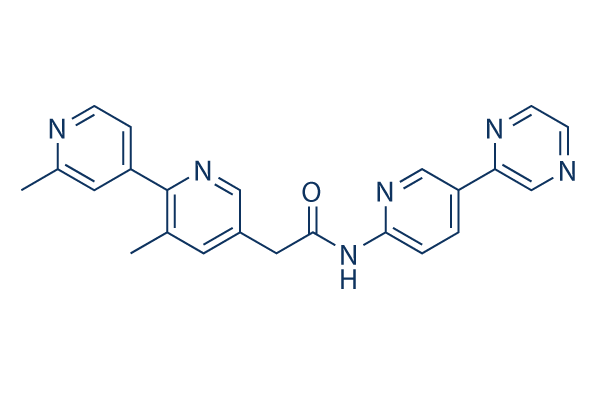
Chemical Structure
Molecular Weight: 396.44
Quality Control
Products Often Used Together with LGK974 (WNT974)
| Related Targets | JAK TGF-beta/Smad Wnt/beta-catenin ERK GSK-3 ROCK Hedgehog/Smoothened PKA Secretase STAT |
|---|---|
| Other PORCN Inhibitors | Wnt-C59 (C59) IWP-L6 IWP-O1 ETC-159 GNF-6231 |
Cell Culture, Treatment & Working Concentration
| Cell Lines | Assay Type | Concentration | Incubation Time | Formulation | Activity Description | PMID |
|---|---|---|---|---|---|---|
| HPAF-II | Growth Inhibition Assay | 1 μM | DMSO | inhibits the growth of pancreatic cancer cell lines with RNF43mutation | 23847203 | |
| PaTu 8988S | Growth Inhibition Assay | 1 μM | DMSO | inhibits the growth of pancreatic cancer cell lines with RNF43mutation | 23847203 | |
| Capan-2 | Growth Inhibition Assay | 1 μM | DMSO | inhibits the growth of pancreatic cancer cell lines with RNF43 mutation | 23847203 | |
| HPAF-II | Growth Inhibition Assay | 1 μM | DMSO | inhibits the growth of pancreatic cancer cell lines with RNF43 mutation | 23847203 | |
| PaTu8988S | Growth Inhibition Assay | 1 μM | DMSO | inhibits the growth of pancreatic cancer cell lines with RNF43 mutation | 23847203 | |
| 293T | Function Assay | IC50 of 0.4 nM to inhibits Wnt signaling in the aforementioned Wnt coculture assay | 24277854 | |||
| 293T | Function Assay | IC50 of 1 nM to compete off [3H]-GNF-1331 in a dose-dependent manner | 24277854 | |||
| HT1080 | Function assay | Inhibition of porcupine activity (unknown origin) expressed in human HT1080 cells assessed as suppression of Wnt3A-mediated super top flash activity by STF luciferase assay, IC50 = 0.0004 μM. | 26522946 | |||
| L Wnt3A, HEK293 | Function assay | 48 hrs | Inhibition of Wnt signaling (unknown origin) expressed in mouse L Wnt3A cells co-cultured with HEK293 cells after 48 hrs by Super-top flash reporter gene assay, IC50 = 0.0009 μM. | 26647303 | ||
| L Wnt3A, HEK293 | Function assay | 48 hrs | Inhibition of porcupine in mouse L Wnt3A cells co-cultured with HEK293 cells after 48 hrs by Super-top flash reporter gene assay, IC50 = 0.0009 μM. | 27692509 | ||
| L Wnt3A, HEK293 | Function assay | 48 hrs | Inhibition of porcupine in mouse L Wnt3A cells co-cultured with HEK293 cells assessed as suppression of Wnt signaling after 48 hrs by Super-top flash reporter gene assay, IC50 = 0.0009 μM. | 29499483 | ||
| HEK293T | Function assay | 0.1 uM | 48 hrs | Inhibition of porcupine (unknown origin) in HEK293T cells transfected with pLibin-WNT3A plasmid assessed as reduction in Wnt3A secretion into cell culture medium at 0.1 uM after 48 hrs by Western blot technique | 26647303 | |
| HEK293T | Function assay | 0.1 uM | 48 hrs | Inhibition of porcupine in HEK293T cells transfected with pLibin-WNT3A plasmid assessed as reduction in Wnt3A secretion into cell culture medium at 0.1 uM after 48 hrs by Western blot method | 27692509 | |
| BT-12 | qHTS assay | qHTS of pediatric cancer cell lines to identify multiple opportunities for drug repurposing: Primary screen for BT-12 cells | 29435139 | |||
| NB1643 | qHTS assay | qHTS of pediatric cancer cell lines to identify multiple opportunities for drug repurposing: Primary screen for NB1643 cells | 29435139 | |||
| OHS-50 | qHTS assay | qHTS of pediatric cancer cell lines to identify multiple opportunities for drug repurposing: Primary screen for OHS-50 cells | 29435139 | |||
| SK-N-MC | qHTS assay | qHTS of pediatric cancer cell lines to identify multiple opportunities for drug repurposing: Primary screen for SK-N-MC cells | 29435139 | |||
| HEK293 | Function assay | 100 nM | 48 hrs | Inhibition of porcupine in HEK293 cells transfected with pLibin-WNT3A plasmid assessed as downregulation of LRP6 phosphorylation at 100 nM after 48 hrs by Western blot analysis | 29499483 | |
| HEK293T | Function assay | 100 nM | 48 hrs | Inhibition of porcupine in HEK293T cells transfected with pLibin-WNT3A plasmid assessed as reduction in Wnt3A secretion into cell culture medium at 100 nM after 48 hrs by Western blot method | 29499483 | |
| PA1 | Function assay | 24 hrs | Inhibition of porcupine-mediated Wnt/beta-catenin signaling in human PA1 cells assessed as downregulation of Axin2 mRNA expression after 24 hrs by real-time PCR analysis | 29499483 | ||
| HEK293 | Function assay | 100 nM | 48 hrs | Inhibition of porcupine in HEK293 cells transfected with pLibin-WNT3A plasmid assessed as downregulation of disheveled 2 phosphorylation at 100 nM after 48 hrs by Western blot analysis | 29499483 | |
| Click to View More Cell Line Experimental Data | ||||||
Solubility
|
In vitro |
DMSO
: 79 mg/mL
(199.27 mM)
Water : Insoluble Ethanol : Insoluble |
Molarity Calculator
|
In vivo |
|||||
In vivo Formulation Calculator (Clear solution)
Step 1: Enter information below (Recommended: An additional animal making an allowance for loss during the experiment)
Step 2: Enter the in vivo formulation (This is only the calculator, not formulation. Please contact us first if there is no in vivo formulation at the solubility Section.)
Calculation results:
Working concentration: mg/ml;
Method for preparing DMSO master liquid: mg drug pre-dissolved in μL DMSO ( Master liquid concentration mg/mL, Please contact us first if the concentration exceeds the DMSO solubility of the batch of drug. )
Method for preparing in vivo formulation: Take μL DMSO master liquid, next addμL PEG300, mix and clarify, next addμL Tween 80, mix and clarify, next add μL ddH2O, mix and clarify.
Method for preparing in vivo formulation: Take μL DMSO master liquid, next add μL Corn oil, mix and clarify.
Note: 1. Please make sure the liquid is clear before adding the next solvent.
2. Be sure to add the solvent(s) in order. You must ensure that the solution obtained, in the previous addition, is a clear solution before proceeding to add the next solvent. Physical methods such
as vortex, ultrasound or hot water bath can be used to aid dissolving.
Chemical Information, Storage & Stability
| Molecular Weight | 396.44 | Formula | C23H20N6O |
Storage (From the date of receipt) | |
|---|---|---|---|---|---|
| CAS No. | 1243244-14-5 | Download SDF | Storage of Stock Solutions |
|
|
| Synonyms | NVP-LGK974, WNT974 | Smiles | CC1=CC(=CN=C1C2=CC(=NC=C2)C)CC(=O)NC3=NC=C(C=C3)C4=NC=CN=C4 | ||
Mechanism of Action
| Features |
Orally bioavailable Porcupine-specific inhibitor that has been tested in Phase I clinical trials for treatment of malignancies dependent on Wnt ligands.
|
|---|---|
| Targets/IC50/Ki |
Porcn
(TM3 cells) |
| In vitro |
In the PORCN radioligand binding assay, LGK974 (WNT974) effectively displaces [3H]-GNF-1331 with an IC50 of 1 nM and shows no major cytotoxicity in cells up to 20 µM. It shows comparable inhibitory activities against all tested Wnts with IC50 ranging from 0.05 to 2.4 nM, which is consistent with the genetic loss of PORCN phenotype. This compound specifically inhibits the growth of three RNF43-mutant cell lines, HPAF-II, PaTu 8988S, and Capan-2.
|
| In vivo |
In a murine MMTV-Wnt1 tumor model and a human head and neck squamous cell carcinoma model (HN30), LGK974 (WNT974) (3 mg/kg) inhibits Wnt signaling in vivo and induces tumor regression without significant body weight loss in the mice. This compound (5 mg/kg, p.o., BID) also inhibits tumor growth of RNF43-mutant pancreatic tumors (HPAF-II and Capan-2) in vivo.
|
References |
|
Applications
| Methods | Biomarkers | Images | PMID |
|---|---|---|---|
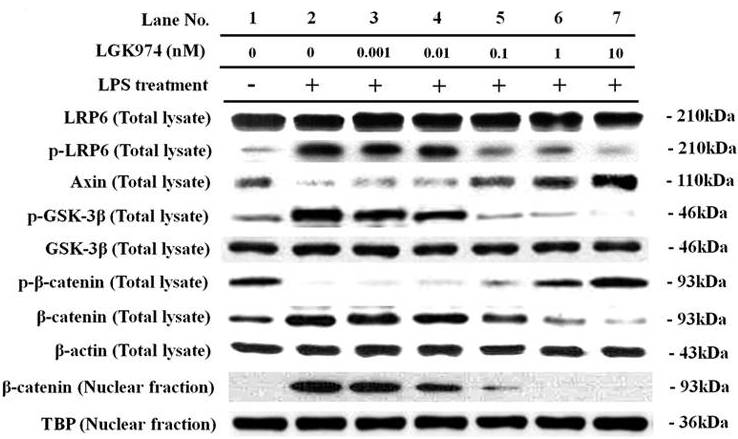
| Western blot | p-LRP6 / Axin / p-GSK3β / p-β-catenin / β-catenin NF-κB / IκB / p-IκB Nrf2 / Wnt3A / HO-1 / NQO-1 / Survivin |
|
28128299 |
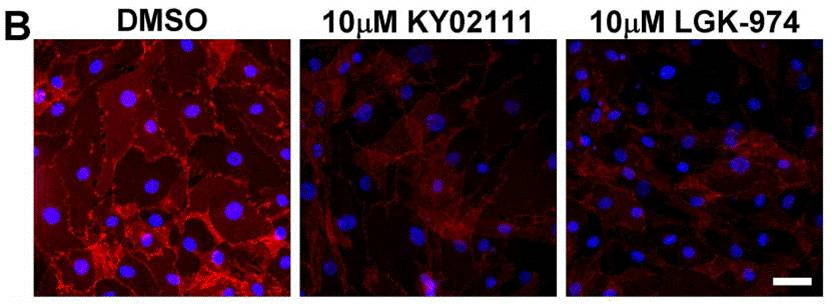
| Immunofluorescence | beta-catenin FUT8 α1, 6-fucosylation |
|
25639201 |
Clinical Trial Information
(data from https://clinicaltrials.gov, updated on 2024-05-22)
| NCT Number | Recruitment | Conditions | Sponsor/Collaborators | Start Date | Phases |
|---|---|---|---|---|---|
| NCT01351103 | Active not recruiting | Pancreatic Cancer|BRAF Mutant Colorectal Cancer|Melanoma|Triple Negative Breast Cancer|Head and Neck Squamous Cell Cancer|Cervical Squamous Cell Cancer|Esophageal Squamous Cell Cancer|Lung Squamous Cell Cancer |
Novartis Pharmaceuticals|Novartis |
December 1 2011 | Phase 1 |
Tech Support
Tel: +1-832-582-8158 Ext:3
If you have any other enquiries, please leave a message.
Frequently Asked Questions
Question 1:
If it is a lipophilic or hydrophilic substance?
Answer:
It is a lipophilic compound.

Products are for research use only. Not for human use. We do not sell to patients.
©Copyright 2013 Selleck Chemicals. All Rights Reserved.