
-
 Australia
-
 Austria
-
 Belgium
-
 Brazil
-
 Canada
-
 China
China
-
 Czech Republic
-
 Denmark
-
 Finland
-
 France
-
 Germany
-
 Greece
-
 Hong Kong
-
 Hungary
-
 Iceland
-
 India
India
-
 Ireland
-
 Israel
-
 Italy
Italy
-
 Japan
Japan
-
 Korea
Korea
-
 Luxembourg
-
 Malaysia
-
 Netherlands
-
 New Zealand
-
 Norway
-
 Poland
-
 Qatar
Qatar
-
 Romania
-
 Saudi Arabia
-
 Singapore
-
 Spain
Spain
-
 Sweden
-
 Switzerland
-
 Taiwan
-
 Turkey
-
 United Kingdom
-
 United States
research use only
CC-5013 (Lenalidomide) Immunomodulator
Cat.No.S1029
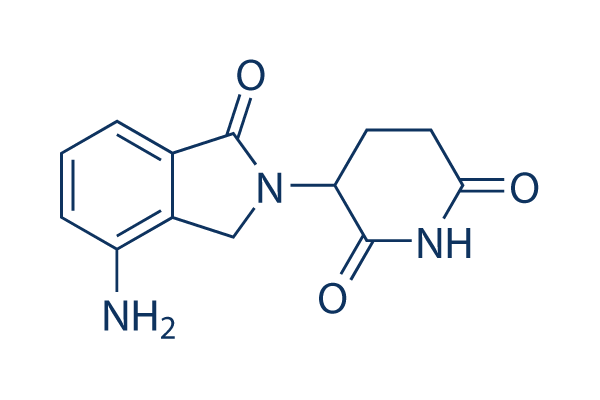
Chemical Structure
Molecular Weight: 259.26
Quality Control
| Related Targets | Proteasome E1 Activating E3 Ligase DUB SUMO p97 E2 conjugating |
|---|---|
| Other E3 ligase Ligand Inhibitors | CC-99282 |
Cell Culture, Treatment & Working Concentration
| Cell Lines | Assay Type | Concentration | Incubation Time | Formulation | Activity Description | PMID |
|---|---|---|---|---|---|---|
| LB771-HNC | Growth Inhibition Assay | IC50=2.15038 μM | SANGER | |||
| L-363 | Growth Inhibition Assay | IC50=2.92212 μM | SANGER | |||
| JAR | Growth Inhibition Assay | IC50=2.97001 μM | SANGER | |||
| EoL-1-cell | Growth Inhibition Assay | IC50=4.10515 μM | SANGER | |||
| BT-549 | Growth Inhibition Assay | IC50=6.21849 μM | SANGER | |||
| SK-NEP-1 | Growth Inhibition Assay | IC50=7.89512 μM | SANGER | |||
| BV-173 | Growth Inhibition Assay | IC50=8.67585 μM | SANGER | |||
| HMV-II | Growth Inhibition Assay | IC50=10.0172 μM | SANGER | |||
| HCC1806 | Growth Inhibition Assay | IC50=11.4467 μM | SANGER | |||
| KASUMI-1 | Growth Inhibition Assay | IC50=11.571 μM | SANGER | |||
| SK-MEL-28 | Growth Inhibition Assay | IC50=11.9764 μM | SANGER | |||
| RPMI-8226 | Growth Inhibition Assay | IC50=12.6241 μM | SANGER | |||
| T47D | Growth Inhibition Assay | IC50=13.2099 μM | SANGER | |||
| HOP-62 | Growth Inhibition Assay | IC50=13.48 μM | SANGER | |||
| A2058 | Growth Inhibition Assay | IC50=13.8199 μM | SANGER | |||
| SW620 | Growth Inhibition Assay | IC50=14.2473 μM | SANGER | |||
| LCLC-103H | Growth Inhibition Assay | IC50=14.4892 μM | SANGER | |||
| HAL-01 | Growth Inhibition Assay | IC50=14.5796 μM | SANGER | |||
| PANC-08-13 | Growth Inhibition Assay | IC50=14.9108 μM | SANGER | |||
| COLO-684 | Growth Inhibition Assay | IC50=15.3979 μM | SANGER | |||
| DEL | Growth Inhibition Assay | IC50=15.499 μM | SANGER | |||
| K5 | Growth Inhibition Assay | IC50=16.1486 μM | SANGER | |||
| SK-MEL-24 | Growth Inhibition Assay | IC50=16.4652 μM | SANGER | |||
| ACN | Growth Inhibition Assay | IC50=16.5297 μM | SANGER | |||
| H9 | Growth Inhibition Assay | IC50=16.626 μM | SANGER | |||
| EM-2 | Growth Inhibition Assay | IC50=17.143 μM | SANGER | |||
| HSC-4 | Growth Inhibition Assay | IC50=17.6601 μM | SANGER | |||
| IGROV-1 | Growth Inhibition Assay | IC50=17.783 μM | SANGER | |||
| TE-1 | Growth Inhibition Assay | IC50=17.9968 μM | SANGER | |||
| LN-405 | Growth Inhibition Assay | IC50=19.9076 μM | SANGER | |||
| MSTO-211H | Growth Inhibition Assay | IC50=20.3573 μM | SANGER | |||
| MOLT-4 | Growth Inhibition Assay | IC50=20.5759 μM | SANGER | |||
| RS4-11 | Growth Inhibition Assay | IC50=22.1563 μM | SANGER | |||
| ES3 | Growth Inhibition Assay | IC50=22.6963 μM | SANGER | |||
| SBC-1 | Growth Inhibition Assay | IC50=23.8696 μM | SANGER | |||
| CTV-1 | Growth Inhibition Assay | IC50=25.0149 μM | SANGER | |||
| HuP-T3 | Growth Inhibition Assay | IC50=25.4009 μM | SANGER | |||
| HCC2218 | Growth Inhibition Assay | IC50=25.5407 μM | SANGER | |||
| HDLM-2 | Growth Inhibition Assay | IC50=28.2026 μM | SANGER | |||
| ABC-1 | Growth Inhibition Assay | IC50=29.6974 μM | SANGER | |||
| MV-4-11 | Growth Inhibition Assay | IC50=29.7317 μM | SANGER | |||
| WM-115 | Growth Inhibition Assay | IC50=30.3099 μM | SANGER | |||
| SW1990 | Growth Inhibition Assay | IC50=30.33 μM | SANGER | |||
| HCC70 | Growth Inhibition Assay | IC50=30.7346 μM | SANGER | |||
| KYSE-520 | Growth Inhibition Assay | IC50=30.8839 μM | SANGER | |||
| JEG-3 | Growth Inhibition Assay | IC50=31.1614 μM | SANGER | |||
| C8166 | Growth Inhibition Assay | IC50=31.2274 μM | SANGER | |||
| SK-OV-3 | Growth Inhibition Assay | IC50=31.6755 μM | SANGER | |||
| NCI-H526 | Growth Inhibition Assay | IC50=32.683 μM | SANGER | |||
| NKM-1 | Growth Inhibition Assay | IC50=32.9568 μM | SANGER | |||
| ECC10 | Growth Inhibition Assay | IC50=34.7443 μM | SANGER | |||
| A2780 | Growth Inhibition Assay | IC50=35.3601 μM | SANGER | |||
| KY821 | Growth Inhibition Assay | IC50=35.7681 μM | SANGER | |||
| MKN1 | Growth Inhibition Assay | IC50=36.2137 μM | SANGER | |||
| EKVX | Growth Inhibition Assay | IC50=37.4212 μM | SANGER | |||
| EW-16 | Growth Inhibition Assay | IC50=38.3885 μM | SANGER | |||
| CTB-1 | Growth Inhibition Assay | IC50=39.7789 μM | SANGER | |||
| COR-L105 | Growth Inhibition Assay | IC50=40.4746 μM | SANGER | |||
| NCI-SNU-5 | Growth Inhibition Assay | IC50=41.2069 μM | SANGER | |||
| Mewo | Growth Inhibition Assay | IC50=41.9871 μM | SANGER | |||
| BCPAP | Growth Inhibition Assay | IC50=43.7917 μM | SANGER | |||
| KARPAS-45 | Growth Inhibition Assay | IC50=44.2776 μM | SANGER | |||
| NCI-H1693 | Growth Inhibition Assay | IC50=46.6986 μM | SANGER | |||
| H-EMC-SS | Growth Inhibition Assay | IC50=48.3224 μM | SANGER | |||
| 697 | Growth Inhibition Assay | IC50=50.3545 μM | SANGER | |||
| KP-N-YS | Growth Inhibition Assay | IC50=52.3142 μM | SANGER | |||
| NCI-H1304 | Growth Inhibition Assay | IC50=52.7024 μM | SANGER | |||
| NOS-1 | Growth Inhibition Assay | IC50=52.8559 μM | SANGER | |||
| NCI-H2342 | Growth Inhibition Assay | IC50=53.0508 μM | SANGER | |||
| KYSE-270 | Growth Inhibition Assay | IC50=53.6364 μM | SANGER | |||
| LU-135 | Growth Inhibition Assay | IC50=55.1853 μM | SANGER | |||
| OE33 | Growth Inhibition Assay | IC50=55.818 μM | SANGER | |||
| ML-2 | Growth Inhibition Assay | IC50=55.9489 μM | SANGER | |||
| KMOE-2 | Growth Inhibition Assay | IC50=56.2893 μM | SANGER | |||
| Daoy | Growth Inhibition Assay | IC50=56.3204 μM | SANGER | |||
| KNS-62 | Growth Inhibition Assay | IC50=57.0142 μM | SANGER | |||
| NBsusSR | Growth Inhibition Assay | IC50=57.5705 μM | SANGER | |||
| UACC-257 | Growth Inhibition Assay | IC50=58.6264 μM | SANGER | |||
| LU-139 | Growth Inhibition Assay | IC50=58.826 μM | SANGER | |||
| CAL-85-1 | Growth Inhibition Assay | IC50=58.8643 μM | SANGER | |||
| NCI-H720 | Growth Inhibition Assay | IC50=58.8942 μM | SANGER | |||
| MLMA | Growth Inhibition Assay | IC50=59.091 μM | SANGER | |||
| A3-KAW | Growth Inhibition Assay | IC50=59.2809 μM | SANGER | |||
| Ramos-2G6-4C10 | Growth Inhibition Assay | IC50=59.6287 μM | SANGER | |||
| A388 | Growth Inhibition Assay | IC50=60.449 μM | SANGER | |||
| LAMA-84 | Growth Inhibition Assay | IC50=60.9905 μM | SANGER | |||
| GCT | Growth Inhibition Assay | IC50=61.0786 μM | SANGER | |||
| K-562 | Growth Inhibition Assay | IC50=61.5333 μM | SANGER | |||
| NCI-H1666 | Growth Inhibition Assay | IC50=61.875 μM | SANGER | |||
| NCI-H1993 | Growth Inhibition Assay | IC50=63.4043 μM | SANGER | |||
| NCI-H358 | Growth Inhibition Assay | IC50=65.0121 μM | SANGER | |||
| NB6 | Growth Inhibition Assay | IC50=65.988 μM | SANGER | |||
| HCE-T | Growth Inhibition Assay | IC50=67.0798 μM | SANGER | |||
| DOK | Growth Inhibition Assay | IC50=67.4948 μM | SANGER | |||
| HT-1376 | Growth Inhibition Assay | IC50=69.8314 μM | SANGER | |||
| NEC8 | Growth Inhibition Assay | IC50=70.1243 μM | SANGER | |||
| G-402 | Growth Inhibition Assay | IC50=70.9395 μM | SANGER | |||
| GR-ST | Growth Inhibition Assay | IC50=71.172 μM | SANGER | |||
| QIMR-WIL | Growth Inhibition Assay | IC50=71.4434 μM | SANGER | |||
| CHP-212 | Growth Inhibition Assay | IC50=71.965 μM | SANGER | |||
| KU812 | Growth Inhibition Assay | IC50=72.9702 μM | SANGER | |||
| Becker | Growth Inhibition Assay | IC50=73.1489 μM | SANGER | |||
| ChaGo-K-1 | Growth Inhibition Assay | IC50=74.7486 μM | SANGER | |||
| A498 | Growth Inhibition Assay | IC50=74.9308 μM | SANGER | |||
| NCI-H69 | Growth Inhibition Assay | IC50=75.7663 μM | SANGER | |||
| NCI-H209 | Growth Inhibition Assay | IC50=78.6147 μM | SANGER | |||
| CAL-33 | Growth Inhibition Assay | IC50=78.9939 μM | SANGER | |||
| COLO-680N | Growth Inhibition Assay | IC50=79.1007 μM | SANGER | |||
| D-283MED | Growth Inhibition Assay | IC50=79.812 μM | SANGER | |||
| ATN-1 | Growth Inhibition Assay | IC50=81.1187 μM | SANGER | |||
| NCI-N87 | Growth Inhibition Assay | IC50=81.7296 μM | SANGER | |||
| MHH-NB-11 | Growth Inhibition Assay | IC50=81.8849 μM | SANGER | |||
| HEL | Growth Inhibition Assay | IC50=82.4134 μM | SANGER | |||
| NB69 | Growth Inhibition Assay | IC50=83.0033 μM | SANGER | |||
| MPP-89 | Growth Inhibition Assay | IC50=83.2575 μM | SANGER | |||
| COLO-829 | Growth Inhibition Assay | IC50=85.4912 μM | SANGER | |||
| ONS-76 | Growth Inhibition Assay | IC50=85.7908 μM | SANGER | |||
| EW-3 | Growth Inhibition Assay | IC50=86.2032 μM | SANGER | |||
| EW-11 | Growth Inhibition Assay | IC50=86.4336 μM | SANGER | |||
| SW900 | Growth Inhibition Assay | IC50=87.2053 μM | SANGER | |||
| MOLT-13 | Growth Inhibition Assay | IC50=87.2243 μM | SANGER | |||
| HuP-T4 | Growth Inhibition Assay | IC50=91.0405 μM | SANGER | |||
| HCC1419 | Growth Inhibition Assay | IC50=91.6374 μM | SANGER | |||
| CAL-72 | Growth Inhibition Assay | IC50=92.0219 μM | SANGER | |||
| Mo-T | Growth Inhibition Assay | IC50=92.7697 μM | SANGER | |||
| OC-314 | Growth Inhibition Assay | IC50=92.8821 μM | SANGER | |||
| BHT-101 | Growth Inhibition Assay | IC50=93.1 μM | SANGER | |||
| EW-18 | Growth Inhibition Assay | IC50=93.8462 μM | SANGER | |||
| TE-12 | Growth Inhibition Assay | IC50=94.3055 μM | SANGER | |||
| MDA-MB-361 | Growth Inhibition Assay | IC50=96.0516 μM | SANGER | |||
| DF15 | Function assay | 4 hrs | Induction of CRL4/CRBN ubiquitin ligase-mediated aiolos degradation in human DF15 cells expressing pLOC-ePL-tagged aiolos after 4 hrs by luminescence based beta-galactosidase enzyme fragmentation complementation assay, EC50 = 0.053 μM. | 28358507 | ||
| DF15 | Function assay | 4 hrs | Induction of cereblon-mediated ikaros degradation in human DF15 cells expressing ePL-tagged ikaros after 4 hrs by luminometric analysis, EC50 = 0.067 μM. | 28425720 | ||
| DF15 | Function assay | 4 hrs | Induction of cereblon-mediated aiolos degradation in human DF15 cells expressing ePL-tagged aiolos after 4 hrs by luminometric analysis, EC50 = 0.087 μM. | 28425720 | ||
| T-cells | Function assay | 2 to 3 days | Inhibition of IL-2 production in human T cells measured after 2 to 3 days by ELISA, EC50 = 0.15 μM. | 23168019 | ||
| NAMALWA | Antiproliferative assay | 72 hrs | Antiproliferative activity against human NAMALWA cells assessed as inhibition of [3H]thymidine incorporation after 72 hrs by scintillation counting, IC50 = 0.36 μM. | 23168019 | ||
| CD34+ progenitor cells | Function assay | 14 days | Decrease in erythroid differentiation of CD34+ progenitor cells from myelodysplastic syndrome del(5q) patient assessed as CD36 expression after 14 days | 17576924 | ||
| CD34+ progenitor cells | Function assay | 14 days | Decrease in myeloid differentiation of CD34+ progenitor cells from myelodysplastic syndrome del(5q) patient assessed as CD33 expression after 14 days | 17576924 | ||
| CD34+ progenitor cells | Function assay | 14 days | Decrease in erythroid differentiation of CD34+ progenitor cells from myelodysplastic syndrome del(5q) patient assessed as glycophorin A expression after 14 days | 17576924 | ||
| CD34+ progenitor cells | Growth inhibition assay | 14 days | Inhibition of cell proliferation of CD34+ progenitor cells from myelodysplastic syndrome del(5q) patient after 14 days | 17576924 | ||
| CD34+ progenitor cells | Growth inhibition assay | 14 days | Growth inhibition of CD34+ progenitor cells from non-del(5q) myelodysplastic syndrome patient after 14 days | 17576924 | ||
| DF15 | Function assay | 0.1 to 10 uM | 5 hrs | Induction of cereblon-mediated aiolos degradation in human DF15 cells at 0.1 to 10 uM after 5 hrs by immunoblot analysis | 28425720 | |
| OPM2 | Function assay | 0.1 to 10 uM | 5 hrs | Induction of cereblon-mediated aiolos degradation in human OPM2 cells at 0.1 to 10 uM after 5 hrs by immunoblot analysis | 28425720 | |
| DF15 | Function assay | 0.1 to 10 uM | 5 hrs | Induction of cereblon-mediated ikaros degradation in human DF15 cells at 0.1 to 10 uM after 5 hrs by immunoblot analysis | 28425720 | |
| OPM2 | Function assay | 0.1 to 10 uM | 5 hrs | Induction of cereblon-mediated ikaros degradation in human OPM2 cells at 0.1 to 10 uM after 5 hrs by immunoblot analysis | 28425720 | |
| EC9706 | Antiproliferative assay | 150 ug/mL | 48 hrs | Antiproliferative activity against human EC9706 cells at 150 ug/mL after 48 hrs by CCK-8 assay | 28757066 | |
| Click to View More Cell Line Experimental Data | ||||||
Solubility
|
In vitro |
DMSO
: 51 mg/mL
(196.71 mM)
Water : Insoluble Ethanol : Insoluble |
Molarity Calculator
|
In vivo |
|||||
In vivo Formulation Calculator (Clear solution)
Step 1: Enter information below (Recommended: An additional animal making an allowance for loss during the experiment)
Step 2: Enter the in vivo formulation (This is only the calculator, not formulation. Please contact us first if there is no in vivo formulation at the solubility Section.)
Calculation results:
Working concentration: mg/ml;
Method for preparing DMSO master liquid: mg drug pre-dissolved in μL DMSO ( Master liquid concentration mg/mL, Please contact us first if the concentration exceeds the DMSO solubility of the batch of drug. )
Method for preparing in vivo formulation: Take μL DMSO master liquid, next addμL PEG300, mix and clarify, next addμL Tween 80, mix and clarify, next add μL ddH2O, mix and clarify.
Method for preparing in vivo formulation: Take μL DMSO master liquid, next add μL Corn oil, mix and clarify.
Note: 1. Please make sure the liquid is clear before adding the next solvent.
2. Be sure to add the solvent(s) in order. You must ensure that the solution obtained, in the previous addition, is a clear solution before proceeding to add the next solvent. Physical methods such
as vortex, ultrasound or hot water bath can be used to aid dissolving.
Chemical Information, Storage & Stability
| Molecular Weight | 259.26 | Formula | C13H13N3O3 |
Storage (From the date of receipt) | |
|---|---|---|---|---|---|
| CAS No. | 191732-72-6 | Download SDF | Storage of Stock Solutions |
|
|
| Synonyms | CC-5013 | Smiles | C1CC(=O)NC(=O)C1N2CC3=C(C2=O)C=CC=C3N | ||
Mechanism of Action
| Targets/IC50/Ki |
CRBN
VEGF
TNF-α
(PBMCs) 13 nM
|
|---|---|
| In vitro |
Lenalidomide strongly induces IL-2 and sIL-2R production. This compound-induced tyrosine phosphorylation of CD28 on T cells is followed by a down-stream activation of NF-κB. This compound and pomalidomide inhibits autoubiquitination of CRBN in HEK293 T cells expressing thalidomide-binding competent wild-type CRBN, but not thalidomide-binding defective CRBN(YW/AA). Overexpression of CRBN wild-type protein, but not CRBN(YW/AA) mutant protein, in KMS12 myeloma cells, amplifies pomalidomide-mediated reductions in c-myc and IRF4 expression and increases in p21(WAF-1) expression. Long-term selection for this compound resistance in H929 myeloma cell lines is accompanied by a reduction in CRBN, while in DF15R myeloma cells resistant to both pomalidomide and this chemical, CRBN protein is undetectable. This chemical prevents induction of defects by down-regulating tumor cell inhibitory molecule expression. It prevents induction of tumor-induced T cell lytic synapse dysfunction. This compound treatment blocks CLL cell-induced T cell actin synapse dysfunction, mimicks antibody blockade, and down-regulates expression of CLL inhibitory ligands and their receptors on T cells. This treatment prevents tumor-induced immune suppression in FL, DLBCL, HL, MM, SCC, and OC and down-regulates immunosuppressive ligand expression on all tumor cells examined. CTL killing function significantly increases following antibody blockade of CLL inhibitory ligands or this chemical treatment compared to control treatments. Treatment of autologous CLL-T cell co-cultures with this agent reverses impaired CD8+ T cell lytic synapse formation and granzyme B trafficking. |
| Kinase Assay |
Assay for inhibition of TNF synthesis by human PBMCs
|
|
Human PBMCs from normal donors are obtained by Ficoll−Hypaque density centrifugation. Cells (106 cells/mL) are cultured in RPMI supplemented with 10 AB+ serum, 2 mM l-glutamine, 100 U/mL penicillin, and 100 μg/mL streptomycin. Lenalidomide is dissolved in DMSO at 20 mg/mL; further dilution is done with culture medium. The final DMSO concentration in all assays including the controls is 0.25%. This compound is added to cells 1 hour prior to the addition of LPS. PBMCs (106 cells/mL) are stimulated with 1 μg/mL of LPS from Salmonella minnesota R595. Cells, in triplicate, are incubated with LPS for 18−20 hours at 37 °C in 5% CO2. Supernatants are then harvested and assayed for cytokine levels. In some experiments, supernatants are kept frozen at −70 °C until use. Cell viability is assayed by Trypan blue exclusion dye method. The concentration of TNFα in the culture supernatants is determined by ELISA. This chemical is assayed in a minimum of three separate experiments. Percent inhibition is determined as 100 × [1 − (cytokine(experimental)/cytokine(control))].
|
|
| In vivo |
The induction of angiogenesis by bFGF is significantly inhibited by oral treatment of Lenalidomide in a dose-dependent manner. This compound significantly decreases the percentage of vascularized area from 5.16% (control group) to 2.58% (50 mg/kg). It significantly reduces the calculated total MVL from 21.07 (control) to 8.11 (50 mg/kg). This chemical significantly inhibites HUVEC migration through the fibronectin-coated membranes towards 0.1 ng/mL of bFGF at 100 μM, 1 ng/mL of VEGF at concentrations of 10 μM and 100 μM. |
References |
|
Applications
| Methods | Biomarkers | Images | PMID |
|---|---|---|---|
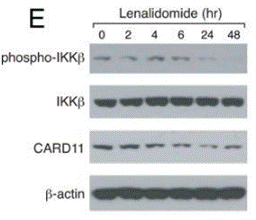
| Western blot | phospho-IKKβ / IKKβ MDM2 / p-MDM2 / p-p53 / p53 |
|
22698399 |
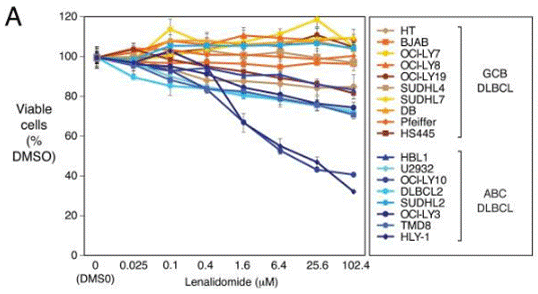
| Growth inhibition assay | Cell viability |
|
22698399 |
Clinical Trial Information
(data from https://clinicaltrials.gov, updated on 2024-05-22)
| NCT Number | Recruitment | Conditions | Sponsor/Collaborators | Start Date | Phases |
|---|---|---|---|---|---|
| NCT06177028 | Not yet recruiting | Cognitive Impairment Mild|Cognitive Dysfunction|Amyloid Plaque|Neurodegenerative Disease Hereditary|Inflammation Brain |
St. Joseph''s Hospital and Medical Center Phoenix|Texas Tech University |
January 2 2024 | Phase 2 |
| NCT06149286 | Recruiting | Relapsed/Refractory Follicular Lymphoma|Marginal Zone Lymphoma (MZL) |
Regeneron Pharmaceuticals |
December 28 2023 | Phase 3 |
| NCT06299553 | Recruiting | DLBCL - Diffuse Large B Cell Lymphoma |
Incyte Biosciences Italy S.r.l |
December 4 2023 | -- |
Tech Support
Tel: +1-832-582-8158 Ext:3
If you have any other enquiries, please leave a message.
Frequently Asked Questions
Question 1:
What is the formulation for its injection (i.p.) in mice?
Answer:
This paper has the information you need: http://link.springer.com/article/10.1208/s12248-012-9401-2. Add it to the appropriate volume of sterile phosphate-buffered saline (PBS) containing 1% hydrochloric acid (HCl). The pH of this preparation was adjusted to 7.0–7.6 using sodium hydroxide and sterile filtered using a 0.22 μm Steriflip filter.
Question 2:
what is the procedure to resuspend it?
Answer:
This compound can be resuspended by DMSO, with a solubility of about 52 mg/mL (200.57 mM). For in vivo study, the working solution can be prepared with the vehicle of: 30% PEG400/0.5% Tween80/5% propylene glycol for oral administration.

Products are for research use only. Not for human use. We do not sell to patients.
©Copyright 2013 Selleck Chemicals. All Rights Reserved.