
-
 Australia
-
 Austria
-
 Belgium
-
 Brazil
-
 Canada
-
 China
China
-
 Czech Republic
-
 Denmark
-
 Finland
-
 France
-
 Germany
-
 Greece
-
 Hong Kong
-
 Hungary
-
 Iceland
-
 India
India
-
 Ireland
-
 Israel
-
 Italy
Italy
-
 Japan
Japan
-
 Korea
Korea
-
 Luxembourg
-
 Malaysia
-
 Netherlands
-
 New Zealand
-
 Norway
-
 Poland
-
 Qatar
Qatar
-
 Romania
-
 Saudi Arabia
-
 Singapore
-
 Spain
Spain
-
 Sweden
-
 Switzerland
-
 Taiwan
-
 Turkey
-
 United Kingdom
-
 United States
research use only
Toremifene Citrate (NK 622) Estrogen/progestogen Receptor modulator
Cat.No.S1776
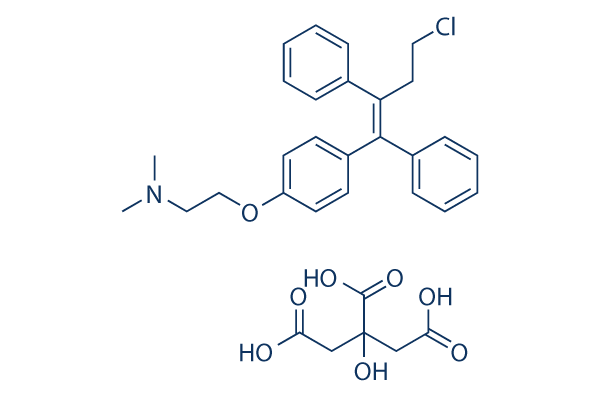
Chemical Structure
Molecular Weight: 598.08
Quality Control
| Related Targets | Adrenergic Receptor GPR Androgen Receptor Glucocorticoid Receptor ACE RAAS Progesterone Receptor Opioid Receptor THR PGES |
|---|---|
| Other Estrogen/progestogen Receptor Inhibitors | Elacestrant (RAD1901) Dihydrochloride Vepdegestrant (ARV-471) MPP dihydrochloride Kaempferol Cholesterol PHTPP G15 Licochalcone A Endoxifen HCl Chrysin |
Solubility
|
In vitro |
DMSO
: 100 mg/mL
(167.2 mM)
Water : Insoluble Ethanol : Insoluble |
Molarity Calculator
|
In vivo |
|||||
In vivo Formulation Calculator (Clear solution)
Step 1: Enter information below (Recommended: An additional animal making an allowance for loss during the experiment)
Step 2: Enter the in vivo formulation (This is only the calculator, not formulation. Please contact us first if there is no in vivo formulation at the solubility Section.)
Calculation results:
Working concentration: mg/ml;
Method for preparing DMSO master liquid: mg drug pre-dissolved in μL DMSO ( Master liquid concentration mg/mL, Please contact us first if the concentration exceeds the DMSO solubility of the batch of drug. )
Method for preparing in vivo formulation: Take μL DMSO master liquid, next addμL PEG300, mix and clarify, next addμL Tween 80, mix and clarify, next add μL ddH2O, mix and clarify.
Method for preparing in vivo formulation: Take μL DMSO master liquid, next add μL Corn oil, mix and clarify.
Note: 1. Please make sure the liquid is clear before adding the next solvent.
2. Be sure to add the solvent(s) in order. You must ensure that the solution obtained, in the previous addition, is a clear solution before proceeding to add the next solvent. Physical methods such
as vortex, ultrasound or hot water bath can be used to aid dissolving.
Chemical Information, Storage & Stability
| Molecular Weight | 598.08 | Formula | C32H36ClNO8 |
Storage (From the date of receipt) | |
|---|---|---|---|---|---|
| CAS No. | 89778-27-8 | Download SDF | Storage of Stock Solutions |
|
|
| Synonyms | NSC 613680,NK 622 Citrate | Smiles | CN(C)CCOC1=CC=C(C=C1)C(=C(CCCl)C2=CC=CC=C2)C3=CC=CC=C3.C(C(=O)O)C(CC(=O)O)(C(=O)O)O | ||
Mechanism of Action
| Targets/IC50/Ki |
Estrogen receptor
|
|---|---|
| In vitro |
Toremifene (7.5 mM) causes approximately 60% of the cells to exhibit morphologic characteristics typical of cells undergoing programmed death, or apoptosis in human breast cancer cells. Toremifene (5-10 mM) results in elevated levels of TRPM-2 and TGF beta 1 mRNAs in in vitro or in vivo grown tumor cells. Toremifene causes growth inhibition of estrogen-sensitive breast cancer cells by inducing some cells to undergo apoptosis and by inhibiting other cells from entering mitosis. Toremifene induces a dose-dependent level of adducts that is lower than that observed for TAM. Toremifene significantly enhances endogenous DNA adduct formation. Toremifene affects the cell turnover by inhibiting mitotic activity and modifying abundant spontaneous apoptosis in DMBA-induced rat mammary carcinoma.
|
| In vivo |
Toremifene, at the highest tested dose, increases the incidence of hepatocellular carcinomas in the DEN-initiated groups to a level one-third that observed with Tamoxifen administration to DEN-initiated rats. Toremifene increases the incidence of hypernephromas in previously DEN-initiated rats. Toremifene results in aneuploidy in 50% of the cells examined and compared with the 85% level induced by Tamoxifen in female Sprague-Dawley rats.
|
References |
|
Clinical Trial Information
(data from https://clinicaltrials.gov, updated on 2024-05-22)
| NCT Number | Recruitment | Conditions | Sponsor/Collaborators | Start Date | Phases |
|---|---|---|---|---|---|
| NCT01214291 | Withdrawn | Risk of Bone Fracture Occurrences |
GTx|Ipsen |
March 2011 | Phase 3 |
| NCT00267553 | Terminated | Breast Neoplasms|Neoplasms Hormone-Dependent |
Intarcia Therapeutics |
November 2005 | Phase 3 |
| NCT00106691 | Completed | Preneoplastic Conditions|Prostatic Intraepithelial Neoplasia |
GTx |
January 2005 | Phase 3 |
Tech Support
Tel: +1-832-582-8158 Ext:3
If you have any other enquiries, please leave a message.
Signaling Pathway Map

Products are for research use only. Not for human use. We do not sell to patients.
©Copyright 2013 Selleck Chemicals. All Rights Reserved.