
-
 Australia
-
 Austria
-
 Belgium
-
 Brazil
-
 Canada
-
 China
China
-
 Czech Republic
-
 Denmark
-
 Finland
-
 France
-
 Germany
-
 Greece
-
 Hong Kong
-
 Hungary
-
 Iceland
-
 India
India
-
 Ireland
-
 Israel
-
 Italy
Italy
-
 Japan
Japan
-
 Korea
Korea
-
 Luxembourg
-
 Malaysia
-
 Netherlands
-
 New Zealand
-
 Norway
-
 Poland
-
 Qatar
Qatar
-
 Romania
-
 Saudi Arabia
-
 Singapore
-
 Spain
Spain
-
 Sweden
-
 Switzerland
-
 Taiwan
-
 Turkey
-
 United Kingdom
-
 United States
research use only
RO4929097 (RG-4733) γ-Secretase inhibitor
Cat.No.S1575
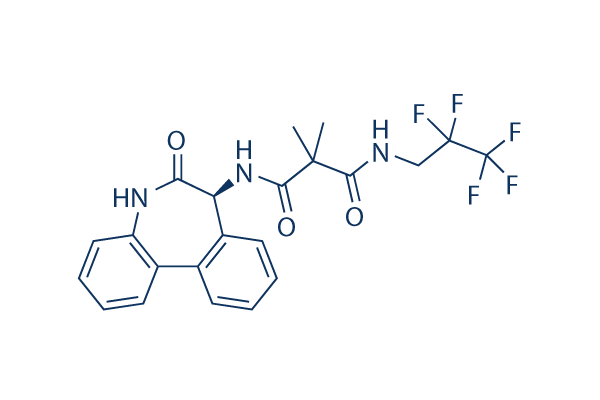
Chemical Structure
Molecular Weight: 469.4
Quality Control
Cell Culture, Treatment & Working Concentration
| Cell Lines | Assay Type | Concentration | Incubation Time | Formulation | Activity Description | PMID |
|---|---|---|---|---|---|---|
| U87 | Cell Viability Assay | 30 μM | 4 d | decreases cell viability | 24495907 | |
| U87 R1 | Cell Viability Assay | 30 μM | 4 d | decreases cell viability | 24495907 | |
| MGG4 | Cell Viability Assay | 30 μM | 4 d | decreases cell viability | 24495907 | |
| MGG6 | Cell Viability Assay | 30 μM | 4 d | decreases cell viability | 24495907 | |
| MGG8 | Cell Viability Assay | 30 μM | 4 d | decreases cell viability | 24495907 | |
| MGG23 | Cell Viability Assay | 30 μM | 4 d | decreases cell viability | 24495907 | |
| SUM149 | Cell Viability Assay | 0-10 μM | 72 h | inhibits cell growth dose dependently | 22547109 | |
| Sum190 | Cell Viability Assay | 0-10 μM | 72 h | inhibits cell growth dose dependently | 22547109 | |
| WM35 | Function Assay | 10 uM | 24 h | DMSO | decreases the levels of NOTCH downstream target HES1 | 21980408 |
| WM98.1 | Function Assay | 10 uM | 24 h | DMSO | decreases the levels of NOTCH downstream target HES1 | 21980408 |
| WM115 | Function Assay | 10 uM | 24 h | DMSO | decreases the levels of NOTCH downstream target HES1 | 21980408 |
| WM983A | Function Assay | 10 uM | 24 h | DMSO | decreases the levels of NOTCH downstream target HES1 | 21980408 |
| WM3248 | Function Assay | 10 uM | 24 h | DMSO | decreases the levels of NOTCH downstream target HES1 | 21980408 |
| WM35 | Growth Inhibition Assay | 10 uM | 0-18 d | DMSO | inhibits cell growth time dependently | 21980408 |
| WM98.1 | Growth Inhibition Assay | 10 uM | 0-18 d | DMSO | inhibits cell growth time dependently | 21980408 |
| WM115 | Growth Inhibition Assay | 10 uM | 0-18 d | DMSO | inhibits cell growth time dependently | 21980408 |
| WM983A | Growth Inhibition Assay | 10 uM | 0-18 d | DMSO | inhibits cell growth time dependently | 21980408 |
| WM3248 | Growth Inhibition Assay | 10 uM | 0-18 d | DMSO | inhibits cell growth time dependently | 21980408 |
| A673 | qHTS assay | 29435139 | ||||
| DAOY | qHTS assay | 29435139 | ||||
| BT-37 | qHTS assay | 29435139 | ||||
| BT-12 | qHTS assay | 29435139 | ||||
| OHS-50 | qHTS assay | 29435139 | ||||
| SJ-GBM2 | qHTS assay | 29435139 | ||||
| SK-N-MC | qHTS assay | 29435139 | ||||
| NB-EBc1 | qHTS assay | 29435139 | ||||
| LAN-5 | qHTS assay | 29435139 | ||||
| Click to View More Cell Line Experimental Data | ||||||
Solubility
|
In vitro |
DMSO
: 94 mg/mL
(200.25 mM)
Ethanol : 50 mg/mL Water : Insoluble |
Molarity Calculator
|
In vivo |
|||||
In vivo Formulation Calculator (Clear solution)
Step 1: Enter information below (Recommended: An additional animal making an allowance for loss during the experiment)
Step 2: Enter the in vivo formulation (This is only the calculator, not formulation. Please contact us first if there is no in vivo formulation at the solubility Section.)
Calculation results:
Working concentration: mg/ml;
Method for preparing DMSO master liquid: mg drug pre-dissolved in μL DMSO ( Master liquid concentration mg/mL, Please contact us first if the concentration exceeds the DMSO solubility of the batch of drug. )
Method for preparing in vivo formulation: Take μL DMSO master liquid, next addμL PEG300, mix and clarify, next addμL Tween 80, mix and clarify, next add μL ddH2O, mix and clarify.
Method for preparing in vivo formulation: Take μL DMSO master liquid, next add μL Corn oil, mix and clarify.
Note: 1. Please make sure the liquid is clear before adding the next solvent.
2. Be sure to add the solvent(s) in order. You must ensure that the solution obtained, in the previous addition, is a clear solution before proceeding to add the next solvent. Physical methods such
as vortex, ultrasound or hot water bath can be used to aid dissolving.
Chemical Information, Storage & Stability
| Molecular Weight | 469.4 | Formula | C22H20F5N3O3 |
Storage (From the date of receipt) | |
|---|---|---|---|---|---|
| CAS No. | 847925-91-1 | Download SDF | Storage of Stock Solutions |
|
|
| Synonyms | RG-4733 | Smiles | CC(C)(C(=O)NCC(C(F)(F)F)(F)F)C(=O)NC1C2=CC=CC=C2C3=CC=CC=C3NC1=O | ||
Mechanism of Action
| Targets/IC50/Ki |
γ secretase
(Cell-free assay) 4 nM
Notch
(Cell-free assay) 5 nM
Aβ40
(Cell-free assay) 14 nM
|
|---|---|
| In vitro |
RO4929097 decreases the amount of Aβ peptides secreted into the culture medium in HEK293 cells with EC50 of 14 nM. This compound strongly inhibits Notch processing with EC50 of 5 nM in the Notch cell-based reporter assay. The potency of this chemical in cell-free and cellular assays is in the low nanomolar range with >100-fold selectivity observed with respect to 75 other proteins of various types including receptors, ion channels, and enzymes (CEREP panel). After 5 days of treatment, it reduces the production of ICN in the human NSCLC A549 cells inducing a flattened and less transformed tumor cell phenotype in tissue culture. It blocks Notch processing in human non-small cell lung carcinoma cells and decreases expression of the Notch transcriptional target gene Hes1. Treatment with this compound reveals a two- to threefold decrease in the expression of direct Notch target genes, Hes1, Hey1, and Heyl in SUM149 and a 3.5- to eightfold decrease in expression in SUM190 cells. It modestly inhibits the growth of SUM149 cells in a dose-dependent manner. At a concentration of 1 μM of this chemical, growth inhibition is 20 % for SUM149 and 10 % for SUM190 cells, relative to vehicle-treated controls. It decreases the production of inflammatory cytokines by T-cells. Furthermore, with this treatment, there is a shift in favor of TH2 over TH1 cytokines. In addition, T-cell activation induced IL-6 production would be increased with this compound. Upon this treatment, the selected melanoma cell lines reveals downregulation of NOTCH downstream effector HES1. A decrease in the amount of melanospheres formed upon this treatment in primary melanoma cell lines is detected.
|
| Kinase Assay |
In vitro potency assays
|
|
After RO4929097 is used, the Aβ peptides are measured by ECL assays using a variety of anti-Aβ antibodies and an Origen 1.5 Analyzer. The 4G8 murine mAb binds an epitope in the Aβ peptide (within amino acids 18–21) that is immediately distal to the α-secretase cleavage site. The G2–10 murine mAb binds the C terminus that is exposed after γ-secretase-mediated cleavage to generate amino acid 40 of the Aβ40 peptide. The FCA3542 rabbit antibody binds the C terminus that is exposed after γ-secretase-mediated cleavage to generate amino acid 42 of the Aβ42 peptide. The 4G8 mAb is biotinylated with biotin-LC-sulfo-N-hydroxysuccinimide-ester. The G2–10 and FCA3542 antibodies are ruthenylated with TAG-N-hydroxysuccinimide ester. Aβ(x-40) is detected with biotinylated 4G8 and ruthenylated G2–10. Aβ(x-42) is detected with biotinylated 4G8 and ruthenylated FCA3542.
|
|
| In vivo |
Oral injection of 3 to 60 mg/kg RO4929097 once daily or twice daily to nude mice bearing A549 NSCLC xenografts for either 7, 14, or 21 days of a 21-day schedule results in significant tumor growth inhibition compared with vehicle-treated animals. The tumor growth inhibition values ranges from 66% to 91%. When mice are treated with 60 mg/kg of this compound twice daily with the 7+/14- schedule, treatment initially arouses regression of established A549 tumors. At the end of the 21-day cycle (day 47), tumor growth prevention is still 91% compared with vehicle control mice. Inhibition of tumor growth remains prolonged and sustained up to 34 days post-treatment (day 67). On day 67, these mice are retreated with the same dose of this chemical for a second cycle (7 days) until day 74. Importantly, the antitumor effects are sustained after dosing is completed. This compound leads to reduced expression of genes associated with angiogenesis in A549 xenograft model. In contrast, the RO4929097-resistant H460a xenograft displays little change in expression of these genes, underscoring the in vivo anti-angiogenesis mechanism of action of this agent. For IL6 and IL8 overexpressing tumors, it no longer impacts angiogenesis or the infiltration of tumor associated fibroblasts.
|
References |
|
Applications
| Methods | Biomarkers | Images | PMID |
|---|---|---|---|
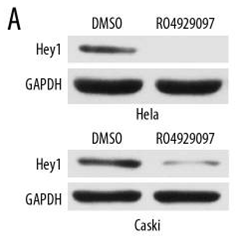
| Western blot | Hey1 Snail / N-cadherin / Twist / E-cadherin Akt / p-Akt / Notch / IGF1R / FBXW7 NICD / Hes1 / Hes3 / Hes5 |
|
29899322 |
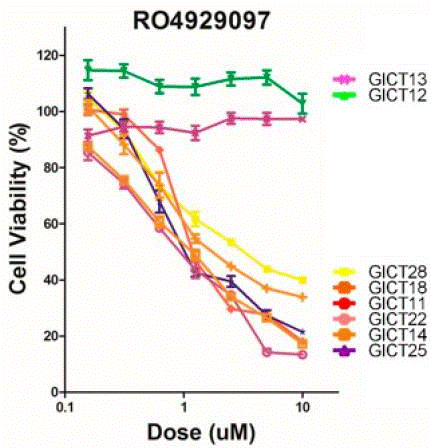
| Growth inhibition assay | Cell viability |
|
30669546 |
Tech Support
Tel: +1-832-582-8158 Ext:3
If you have any other enquiries, please leave a message.
Frequently Asked Questions
Question 1:
How about its half-life?
Answer:
Its half-life is about 20 hours based on the following paper: http://www.ncbi.nlm.nih.gov/pmc/articles/PMC3869895/

Products are for research use only. Not for human use. We do not sell to patients.
©Copyright 2013 Selleck Chemicals. All Rights Reserved.