
-
 Australia
-
 Austria
-
 Belgium
-
 Brazil
-
 Canada
-
 China
China
-
 Czech Republic
-
 Denmark
-
 Finland
-
 France
-
 Germany
-
 Greece
-
 Hong Kong
-
 Hungary
-
 Iceland
-
 India
India
-
 Ireland
-
 Israel
-
 Italy
Italy
-
 Japan
Japan
-
 Korea
Korea
-
 Luxembourg
-
 Malaysia
-
 Netherlands
-
 New Zealand
-
 Norway
-
 Poland
-
 Qatar
Qatar
-
 Romania
-
 Saudi Arabia
-
 Singapore
-
 Spain
Spain
-
 Sweden
-
 Switzerland
-
 Taiwan
-
 Turkey
-
 United Kingdom
-
 United States
research use only
FK506 (Tacrolimus) Calcineurin inhibitor
Cat.No.S5003
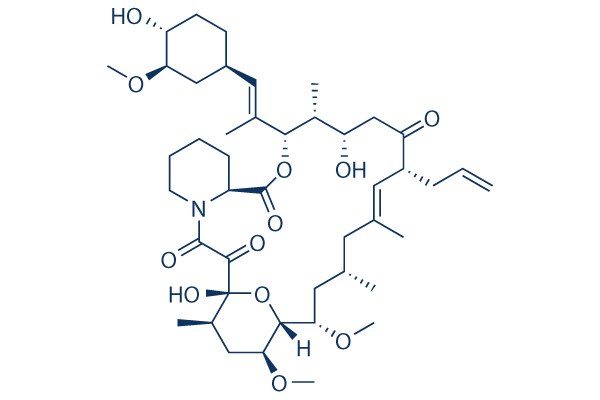
Chemical Structure
Molecular Weight: 804.02
Quality Control
| Related Targets | PI3K Akt mTOR GSK-3 ATM/ATR DNA-PK AMPK PDPK1 PTEN PP2A |
|---|---|
| Other FKBP Inhibitors | dTAG-13 Rimiducid (AP1903) Shield-1 (Shld1) AP20187 (B/B Homodimerizer) S107 hydrochloride dTAGV-1 TFA SAFit2 |
Cell Culture, Treatment & Working Concentration
| Cell Lines | Assay Type | Concentration | Incubation Time | Formulation | Activity Description | PMID |
|---|---|---|---|---|---|---|
| human U251 cells | Function assay | Inhibition of SAP130 in VEGF-stimulated human U251 cells by PLAP reporter gene assay, IC50=13.8 nM | 17643112 | |||
| human WiDr cells | Growth inhibition assay | Inhibition of SAP130 mediated cell growth in human WiDr cells, IC50=10.9 nM | 17643112 | |||
| human T-cell | Proliferation assay | In vitro inhibitory activity against human T-cell proliferation, IC50=0.5 nM | 7537331 | |||
| rat RBL2H3 cells | Function assay | 15 mins | Antiinflammatory activity in rat RBL2H3 cells assessed as inhibition of DNP-BSA-induced TNF-alpha production preincubated for 15 mins prior DNP-BSA challenge measured after 30 mins by ELISA, IC50=0.25 nM | 22410084 | ||
| rat RBL2H3 cells | Function assay | 16 h | Inhibition of TNF-alpha production in rat RBL2H3 cells after 16 hrs by ELISA, IC50=0.25 nM | 23791076 | ||
| PBMCs | Function assay | Inhibitory activity against IFN-gamma production (Anti-CD3 monoclonal antibody stimulated and cultured CD4 positive cells purified from human peripheral blood mononuclear cell), IC50 = 0.00006 μM. | 15369399 | |||
| PBMCs | Function assay | Inhibitory activity against IL-5 production (Anti-CD3 monoclonal antibody stimulated and cultured CD4 positive cells purified from human peripheral blood mononuclear cell), IC50 = 0.00006 μM. | 15369399 | |||
| T-cells | Function assay | The compound was tested for its inhibitory activity against T-cell proliferation using murine splenic T-cells, IC50 = 0.0002 μM. | 10450987 | |||
| RBL-2H3 | Function assay | Inhibition of DNP7-BSA antigen-induced TNFalpha release in rat RBL-2H3 cells, IC50 = 0.00025 μM. | 16901696 | |||
| Jurkat T | Immunosuppressive assay | 15 to 30 mins | Immunosuppressive activity in PMA/ionomycin stimulated human Jurkat T cells assessed as suppression of IL2 production pretreated for 15 to 30 mins followed by PMA/ionomycin addition measured after 18 to 20 hrs by ELISA, IC50 = 0.36 μM. | 28412204 | ||
| HEK293 | Function assay | TP_TRANSPORTER: inhibition of Phalloidin uptake (Phalloidin: 1 uM) in OATP-C-expressing HEK293 cells, IC50 = 3.7 μM. | 14530907 | |||
| Jurkat T | Antiinflammatory assay | 20 mins | Anti-inflammatory activity in PMA/ionomycin stimulated human Jurkat T cells assessed as reduction in IL-2 secretion preincubated for 20 mins followed by PMA/ionomycin stimulation measured after 12 hrs by ELISA, IC50 = 5.8 μM. | 28509552 | ||
| Click to View More Cell Line Experimental Data | ||||||
Solubility
|
In vitro |
DMSO
: 120 mg/mL
(149.25 mM)
Ethanol : 100 mg/mL Water : Insoluble |
Molarity Calculator
|
In vivo |
|||||
In vivo Formulation Calculator (Clear solution)
Step 1: Enter information below (Recommended: An additional animal making an allowance for loss during the experiment)
Step 2: Enter the in vivo formulation (This is only the calculator, not formulation. Please contact us first if there is no in vivo formulation at the solubility Section.)
Calculation results:
Working concentration: mg/ml;
Method for preparing DMSO master liquid: mg drug pre-dissolved in μL DMSO ( Master liquid concentration mg/mL, Please contact us first if the concentration exceeds the DMSO solubility of the batch of drug. )
Method for preparing in vivo formulation: Take μL DMSO master liquid, next addμL PEG300, mix and clarify, next addμL Tween 80, mix and clarify, next add μL ddH2O, mix and clarify.
Method for preparing in vivo formulation: Take μL DMSO master liquid, next add μL Corn oil, mix and clarify.
Note: 1. Please make sure the liquid is clear before adding the next solvent.
2. Be sure to add the solvent(s) in order. You must ensure that the solution obtained, in the previous addition, is a clear solution before proceeding to add the next solvent. Physical methods such
as vortex, ultrasound or hot water bath can be used to aid dissolving.
Chemical Information, Storage & Stability
| Molecular Weight | 804.02 | Formula | C44H69NO12 |
Storage (From the date of receipt) | |
|---|---|---|---|---|---|
| CAS No. | 104987-11-3 | Download SDF | Storage of Stock Solutions |
|
|
| Synonyms | FR900506, Fujimycin | Smiles | CC1CC(C2C(CC(C(O2)(C(=O)C(=O)N3CCCCC3C(=O)OC(C(C(CC(=O)C(C=C(C1)C)CC=C)O)C)C(=CC4CCC(C(C4)OC)O)C)O)C)OC)OC | ||
Mechanism of Action
| Targets/IC50/Ki |
FKBP12
(T cells) calcineurin
|
|---|---|
| In vitro |
Tacrolimus (FK506) and cyclosporin A block translocation of the cytoplasmic component without affecting synthesis of the nuclear subunit in T lymphocytes. This compound prevents T-cell proliferation by inhibiting a Ca(2+)-dependent event required for induction of interleukin-2 transcription. It binds to distinct families of intracellular proteins (immunophilins) termed cyclophilins and FK 506-binding proteins (FKBPs). Tacrolimus specifically inhibits cellular calcineurin at drug concentrations that inhibit interleukin 2 production in activated T cells. It and CsA exert nearly identical biological effects in cells by inhibiting the same subset of early calcium-associated events involved in lymphokine expression, apoptosis, and degranulation. This compound binds to a family of intracellular receptors termed the FK-506 binding proteins (FKBPs). |
| In vivo |
Tacrolimus (FK506) results in an increase in the paw and tail withdrawal threshold as revealed by behavioral pain assessment in rats against hyperalgesic and allodynic stimuli. It also leads to a decrease in the serum nitrate and thiobarbituric acid reactive substance (TBARS) levels along with reduction in tissue myeloperoxidase (MPO) and total calcium levels, whereas, rise in tissue reduced glutathione levels in rats. This compound ameliorates the increase in the neuronal edema and axonal degeneration in rats with ischemia reperfusion (I/R). |
References |
|
Applications
| Methods | Biomarkers | Images | PMID |
|---|---|---|---|
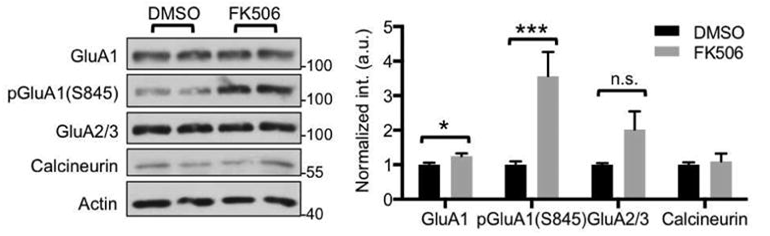
| Western blot | GluA1 / pGluA1(S845) / GluA2 / GluA3 / Calcineurin p-JNK / JNK / p-ERK / ERK / Cytochrome c / cleaved caspase-3 p-S6K(S371) / S6K / p-Erα(S167) / Erα |
|
26455952 |
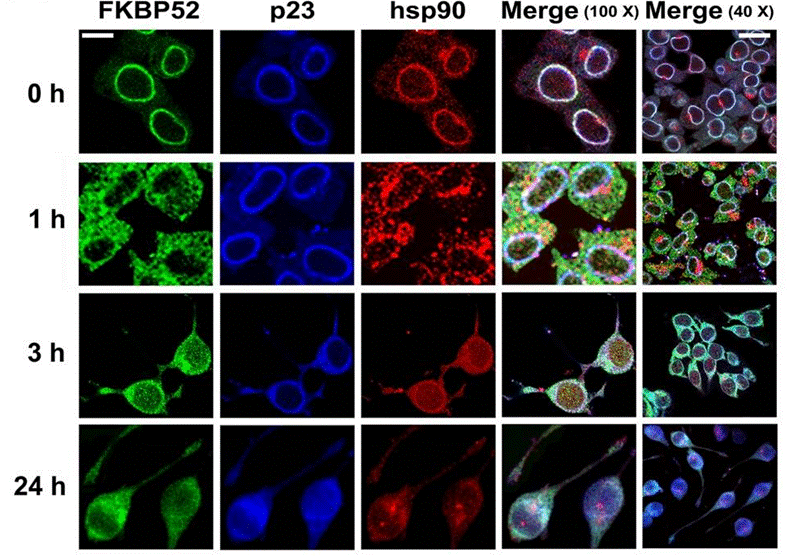
| Immunofluorescence | FKBP52 / p23 / hsp90 FKBP51 Tom20 / JC-1 / ROS / NF-κB |
|
20796173 |
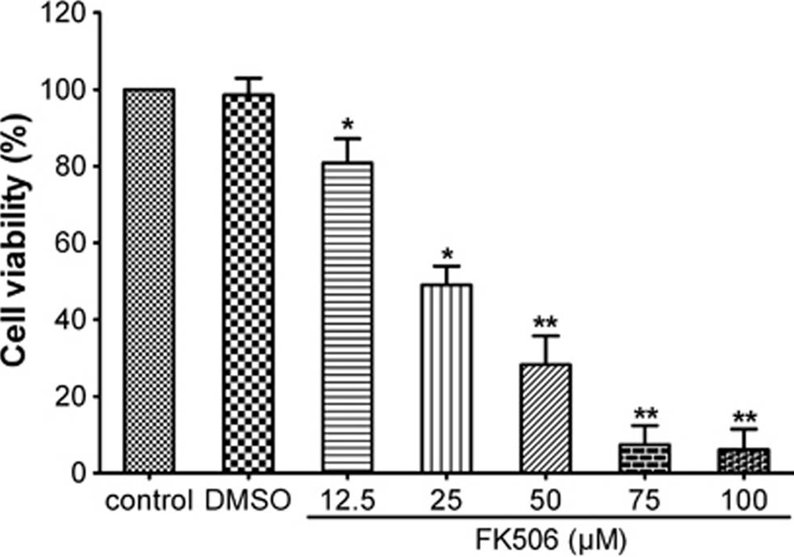
| Growth inhibition assay | Cell viability |
|
23470533 |
Clinical Trial Information
(data from https://clinicaltrials.gov, updated on 2024-05-22)
| NCT Number | Recruitment | Conditions | Sponsor/Collaborators | Start Date | Phases |
|---|---|---|---|---|---|
| NCT05702931 | Not yet recruiting | Hyperglycemia|Renal Transplant Complication Primary Non-Function|Diabetes |
Rigshospitalet Denmark|Aarhus University Hospital|Odense University Hospital |
April 1 2024 | Phase 4 |
| NCT06268769 | Recruiting | Immunosuppression |
Edward Geissler|Chiesi Pharmaceuticals GmbH|University of Regensburg |
March 9 2024 | Phase 4 |
| NCT06326775 | Active not recruiting | Heart Transplant Patients |
Nanjing First Hospital Nanjing Medical University|Wuhan Union Hospital China|Changhai Hospital|Shanghai Zhongshan Hospital |
March 12 2024 | -- |
| NCT06235892 | Not yet recruiting | Organ Grafts |
Nantes University Hospital |
February 10 2024 | Phase 3 |
Tech Support
Tel: +1-832-582-8158 Ext:3
If you have any other enquiries, please leave a message.
Frequently Asked Questions
Question 1:
We would like to inject it subcutaneously into rats. Can we mix it with 5% dextrose to a concentration of 5mg/ml to prepare the solution?
Answer:
You can dissolve it with DMSO to prepare the stock solution, and then dilute by 5% dextrose. However, we don't have the information about the solubility in this condition. Or you can use the vehicle we tested: 30% PEG400/0.5% Tween80/5% propylene glycol (Solubility: 30mg/ml).

Products are for research use only. Not for human use. We do not sell to patients.
©Copyright 2013 Selleck Chemicals. All Rights Reserved.